How to Launch an AI Product When You Have No Audience
No audience, no problem. A step-by-step plan to launch an AI product: find your first users, build in public, and turn early traction into real customers.
You built something with AI, and nobody knows it exists. That is the normal starting point, not a failure. This post explains how to launch an AI product when you have no audience: pick a narrow user, go to where they already are, talk to them one by one, and use small public proof to bring in the next ones.
If you want the underlying lessons on building and launching, AI Entrepreneur is a free web app of short, hands-on lessons that covers them. Every lesson is free with an account.
How to launch an AI product when you have no audience: aim for learning, not reach
A big audience helps you reach many people. It does not tell you whether anyone wants what you made. At the start you need a small number of people with a real problem, not a crowd.
A handful of people who use your product and tell you the truth teach you more than a pile of followers who never try it. You can find a handful without a following. It takes a clear target, some direct messages and patience.
So the goal of a no-audience launch is learning, not attention: who needs this, what they will pay for and what to fix first.
Start with one narrow problem and one specific user
"AI assistant for small businesses" is not a launch. Nobody can picture that person, and you cannot find them. Compare it with "a tool that turns a plumber's rough job notes into a clear quote." You can picture the user, search for them and write to them.
Write one sentence before you do anything else:
I help [specific person] do [specific job] without [specific pain].
If you cannot fill in all three blanks with something concrete, keep narrowing. The AI Entrepreneur course Finding AI Opportunities covers where good ideas come from and how to check whether you are building a thin wrapper or a real product. A narrow user with a real pain is also the best defense against looking like a copy of everything else.
Find where your first users gather and reach them by hand
You do not need to build an audience if you can join one that already exists. Your target user is probably already in a few places:
- Online forums and subreddits about their trade or hobby.
- Slack or Discord groups for their profession.
- Newsletters, comment sections and professional networks where they talk about their work.
Spend a week reading before you post anything. Note the exact words people use to describe the problem, what they complain about and what workarounds they use. Those phrases become your landing page copy and your first messages. Check each community's rules on self-promotion before you share anything. Many restrict it, so being useful first, by answering questions, is the safer way in.
Then reach people by hand. This does not scale, and that is fine. It is also the best way to learn. Send short, specific messages to people who clearly have the problem, and ask about their work instead of pitching. Here is an example for the quote tool:
Hi Sam, I saw your post about spending Sunday nights writing up quotes. I'm building a small tool that turns rough job notes into a clean quote. Could I ask you three questions about how you do it today? No sales pitch, I'm trying to learn.
That message names a real thing they said, asks for a small favor and says what it is for. It is more likely to get a reply than a generic announcement.
When someone agrees to try the product, onboard them yourself. Get on a call or send a message and watch them use it. Do the hard parts for them if you need to. You will see where they get stuck, which no analytics dashboard shows this early.
Our post on how to get your first 10 customers goes deeper on this stage. The AI Entrepreneur lesson Talking to Customers Without Fooling Yourself covers how to ask questions that give honest answers instead of polite ones.
Share proof and capture early demand
Build in public, with proof instead of hype
Building in public means sharing what you are making as you make it. With no audience, you start with almost no readers, and that is fine. The posts still work as a record, and they give people something to find when you message them.
Share things that are specific and checkable:
- A before and after of a real task your product handled.
- What you learned from a user call, and what you changed because of it.
- A mistake your product made and how you fixed it.
- A short screen recording of the product doing one job.
Show the output instead of vague claims. If your product sometimes gets things wrong, say so and show how you handle it; see why AI makes things up and what builders can do about it.
Use a waitlist and a demo
You do not need a finished product to learn whether people care. A simple landing page with a clear promise, a short demo and a sign-up box can test demand quickly. Your page needs four things:
- One headline that names the user and the outcome.
- A short demo, such as a recording or a few real examples of input and output.
- A single call to action, such as joining the waitlist.
- One question on the sign-up form, such as "What do you do today instead?"
That last question is useful. The answers tell you who signs up and what you are really competing with. AI Entrepreneur's first hands-on project, A Landing Page and a Waitlist, walks through building exactly this. The next one, A Prompt-Powered Micro Tool, is about making a small working tool around a prompt.
When people join, email them: say thanks, ask what they hoped to do and offer a short call. A waitlist you never talk to is just a list.
Launch on Product Hunt, Hacker News and niche communities
Launch sites can bring a burst of visitors, and they are worth using. But treat them as one step, not the plan. A spike only helps if your page already explains the product well and you can handle the people who arrive.
- Niche communities first. The people there match your user. Share what you made and ask for honest feedback, following each group's rules.
- Launch sites next. Prepare a clear title, a short description, a demo and a way to try the product quickly. Read each site's posting guidelines before you submit, and be in the comments to answer questions.
- Follow up with everyone who tried it. Thank them and ask what happened. The conversation after the launch is worth more than the launch.
No single post makes or breaks you. A launch that gets little attention is still information. The lesson Distribution: Getting in Front of Customers covers how customers actually find a product, and it is a good reality check before you plan a launch day.
A one-week plan for the quote tool
Here is the plan applied to the plumber example. The tool and the numbers are made up for illustration.
- Day 1: write the sentence: "I help plumbers turn rough job notes into a clear quote without losing Sunday night."
- Days 2 and 3: read two trade forums and a group chat. Write down five phrases plumbers use about quoting.
- Days 4 and 5: send five messages like the one above. Ask for a three-question chat, not a sale.
- Day 6: put up a one-page site with a recorded demo, the waitlist button and the "What do you do today instead?" question.
- Day 7: thank everyone who replied, offer the first two a hands-on trial, and list what you heard.
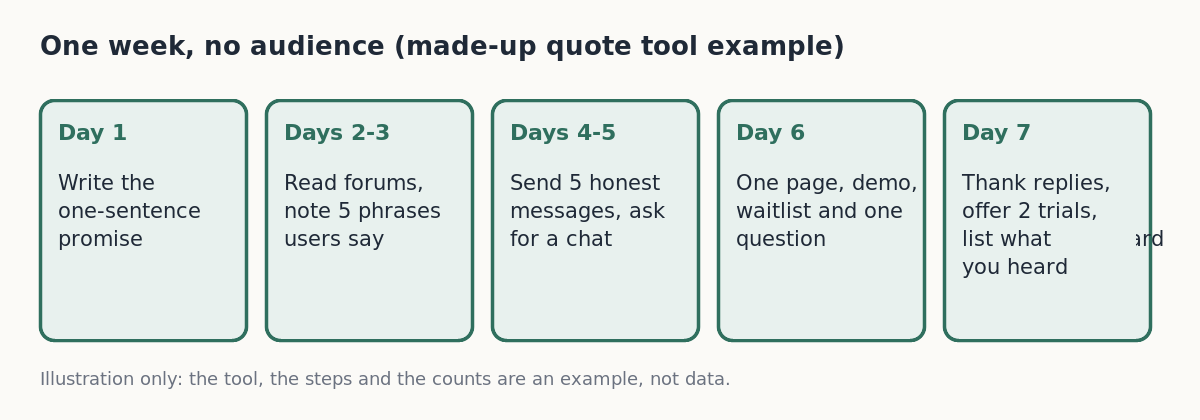
At the end of the week you have a sharper idea of the user, a few real conversations and maybe two people trying the product. That is a launch.
Turn early users into feedback, referrals and revenue
Feedback. Ask each early user the same short questions. What were you trying to do? Did it work? What almost made you quit? Look for patterns across several people before you change anything. If you ship an AI feature, also start checking output quality in a repeatable way. Our post on LLM evals explains how.
Referrals. A happy user can introduce you to others in the same trade. Ask directly: "Who else do you know who has this problem?" A warm introduction beats a cold message.
Revenue. Do not wait too long to ask for money. Paying is the clearest sign that the problem is real. Decide your price with your costs in mind, because AI products have a cost on every request. Read how to price an AI product without losing money per user before you set it.
Frequently asked questions
Do I need a social media following to launch an AI product?
No. You need a small number of people with the problem, and you can reach them through communities, direct messages and introductions. A following can help later, but it is not required to start.
How many users should I aim for first?
Aim for about ten people who actually use the product and talk to you. That is enough to see patterns and fix the biggest problems before you try to reach more.
Should I build the full product before I launch?
No. Ship the smallest thing that teaches you something. A landing page, a demo and a waitlist can show whether people care before you spend weeks building.
When should I launch on Product Hunt or Hacker News?
After you have tried the product with a few real users and have a clear page and demo. Read each site's guidelines first, and be ready to answer comments on the day.
Can I learn this without paying for a course?
Yes. AI Entrepreneur has 12 courses and 36 lessons, and every lesson is free with an account. It teaches the skills, but it does not build or run a business for you and cannot promise results.
Get started
Pick one narrow user this week. Write your one-sentence promise, find the place they gather and send five honest messages. Then build the smallest page or demo that lets them respond.
If you want guided practice, the Launch, Price and Get Paid course in AI Entrepreneur covers the MVP and the build-measure-learn loop, pricing AI products and winning your first ten customers by hand.
Every lesson is free. Start learning with AI Entrepreneur: sign in on the home page with a 6-digit code sent to your email and take your first short lesson today.