What Are Unit Economics? A Guide for First-Time Founders
What are unit economics? Learn how CAC, LTV, gross margin and payback work, with simple examples first-time founders can use to test if a business can profit.
If you are asking what are unit economics, the short answer is this: unit economics tell you whether you make or lose money on one customer, one order or one request. Get that one number right and the rest of the business has something solid to stand on. Get it wrong and growth only makes the loss bigger.
What are unit economics in plain words
A "unit" is the smallest thing you sell. It might be one subscriber for a month, one order, or one report your tool produces. Unit economics ask a simple question: when you sell one unit, how much money comes in, how much goes out, and what is left?
Say you run a small AI tool that charges $25 a month. Each customer costs you $10 a month to serve. The unit is one customer for one month. You keep $15. That $15 is what pays for your time, your tools, your marketing and, eventually, your profit.
You do not need an accounting degree. You need a few numbers and the habit of checking them.
Why unit economics matter before you scale
Scaling multiplies whatever you already have. If you make $15 on each customer, ten times the customers means ten times the $15. If you lose $3 on each customer, ten times the customers means ten times the loss.
That is why it pays to check the unit before you spend on growth. A business that loses money on every sale cannot fix the problem with volume. It can only fix it with a change to price, cost or both.
It also fits how small you should start. If you are still deciding what to build first, read what an MVP is and how small version one should be. A small first version gives you real numbers sooner, and real numbers are what unit economics need.
The core numbers: revenue per unit, variable costs and contribution margin
Three numbers do most of the work.
- Revenue per unit. What one customer or one order pays you. If you charge $25 a month, that is $25.
- Variable costs per unit. Costs that rise with each extra unit. Payment fees, hosting that grows with use, support time, and for AI products, the cost of calling a model.
- Contribution margin. Revenue per unit minus variable costs per unit. It is the money each unit leaves behind to cover everything else.
Fixed costs are different. Your domain name or a flat monthly software fee does not change when you add a customer. Keep them out of the per-unit math and cover them from the contribution margin you collect.
You can also show contribution margin as a percentage. In the example above, $15 out of $25 is 60 percent. The percentage lets you compare products with different prices.
The AI Entrepreneur course Business Basics for Builders covers this ground in its lesson Revenue, Costs and Unit Economics. It is a Basic level course, which the app describes as needing no background.
Customer acquisition cost (CAC) and lifetime value (LTV)
Contribution margin tells you what one sale leaves. Two more numbers tell you whether the customer is worth the effort of finding them.
- Customer acquisition cost (CAC). What you spend to win one new customer. Add up your marketing and sales spend for a period, then divide by the number of new customers it brought in.
- Lifetime value (LTV). The total contribution margin one customer gives you before they leave. A simple version: monthly contribution margin times the number of months an average customer stays.
The test is whether LTV is comfortably larger than CAC. If you spend $60 to win a customer who leaves you $42 of margin over their whole stay, you lose money on every customer you add.
Early on, your CAC may be close to zero because you find your first customers by hand. That is fine. The lesson Launching and the First Ten Customers is about winning them by hand. But the number changes once you pay for reach, so track it from the start. How customers find you also shapes CAC, which is why choosing the right distribution channel matters.
How to calculate unit economics step by step with an example
Here is a worked example. You sell a tool that turns meeting notes into a summary. The price is $25 a month. The numbers below are made up to show the method, not benchmarks.
- Pick the unit. One paying customer for one month.
- Write down revenue per unit. $25.
- List variable costs per unit. Model usage $7, payment fees $1, support time $2. Total $10.
- Find contribution margin. $25 minus $10 is $15, or 60 percent.
- Estimate how long customers stay. Say 8 months on average. LTV is $15 times 8, which is $120.
- Work out CAC. You spent $200 on a small test and won 5 customers. CAC is $40.
- Compare. $120 against $40. LTV is three times CAC, so the unit looks healthy.
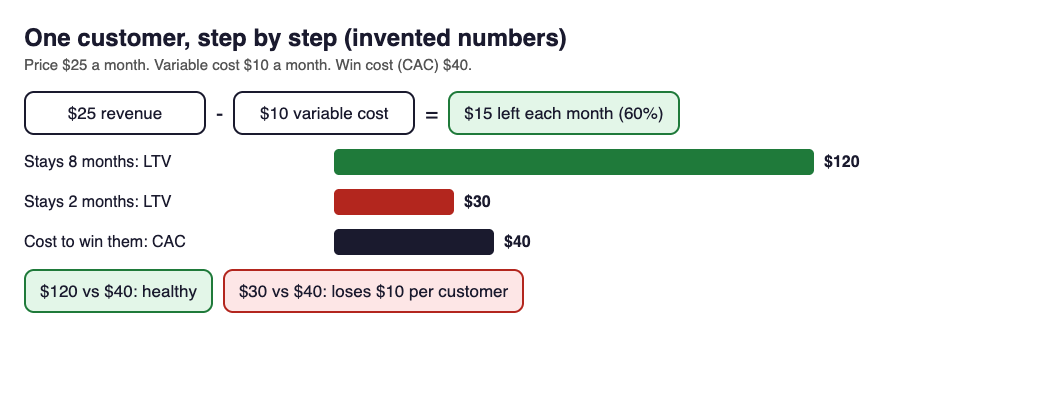
Now stress it. If customers stay only 2 months, LTV drops to $30, which is less than CAC. The business now loses money on each customer. The same product turns bad because of one assumption, so test your assumptions with real data as soon as you have any.
To get real data, you need real signals of demand first. The post on testing demand with a landing page and a waitlist shows a cheap way to start.
Unit economics for AI products: inference costs and usage-based margins
AI products have a feature that many software products do not: every request has a cost. Each time a user asks your product to do something, you call a model, and the provider charges for what goes in and what comes out. The AI Entrepreneur lesson Model APIs, Tokens and What a Request Costs is about what a request costs.
That makes your variable cost depend on how much each customer uses the product. Two customers on the same $25 plan can have very different margins. One sends ten requests a month. Another sends a thousand.
To see why, it helps to know what a model is doing under the hood. How large language models work explains next-token prediction, and that process is what you pay for, token by token.
A practical way to work this out:
- Estimate the cost of one typical request.
- Estimate how many requests a light, average and heavy user makes in a month.
- Multiply, and compare each result with the price you charge.
If your heaviest users cost more than they pay, you have a few choices. You can set a usage limit, charge by usage, or choose a smaller model for simple jobs. The lessons Choosing Models: Big, Small, Open, Closed and Pricing AI Products are about those choices. Retrieval can change your costs too, because what you send with each request adds to it. See retrieval-augmented generation in plain words for what that involves.
Common unit economics mistakes first-time founders make
- Counting revenue and ignoring variable cost. A busy product can still lose money on each sale.
- Using the average user. Averages hide heavy users who cost more than they pay.
- Leaving out your own time. If you do support by hand, that time is a cost, even if you do not pay yourself yet.
- Guessing retention. "Customers will stay a year" is a hope until you watch real customers.
- Mixing fixed and variable costs. This blurs what one extra customer really costs you.
- Treating a model price as permanent. If you build on someone else's model, its price and terms can change. The lesson Building on Someone Else's Model is about that risk.
How to improve your unit economics
You have only a few levers. Pull them one at a time so you can see what worked.
- Raise the price. Often the fastest fix, and one first-time founders avoid. Test it with new customers.
- Cut variable cost. Use a smaller model for easy tasks, shorten what you send in each request, and set sensible usage limits.
- Keep customers longer. Longer stays raise LTV. Talk to customers who leave and find out why.
- Lower CAC. Focus on the one channel that works instead of spreading thin.
- Change the unit. Charge per use or per seat if flat pricing hides cost differences.
As the numbers improve, you will want a plan for what comes next. The roadmap from side project to AI company in 7 stages shows where unit economics fit in the longer path.
Frequently asked questions
What are unit economics in simple terms?
They are the revenue and costs of one unit, such as one customer or one order. They show whether you make or lose money each time you sell.
What is a good LTV to CAC ratio?
LTV should be clearly higher than CAC, otherwise you lose money winning customers. There is no single number that fits every business, so set your own target based on your costs, how long customers stay and how much risk you can carry.
Do I need unit economics if I have no customers yet?
Yes, as estimates. A rough calculation before you build shows whether your price can cover your costs, and you can replace each guess with real data as customers arrive.
Why are unit economics harder for AI products?
Every request calls a model that charges for usage, so your cost grows with how much each customer uses the product. A flat price can look fine on average and still lose money on heavy users.
Get started
The numbers in this guide are easier to learn when you work with them. AI Entrepreneur has short, hands-on lessons on revenue, costs and unit economics, plus model costs and pricing for AI products. Every lesson is free with an account. Start learning with AI Entrepreneur: sign in on the home page with a 6-digit code sent to your email and take your first short lesson today.