What Moats Still Work When Anyone Can Call the Same Model
What moats still work when every rival can call the same AI model? Learn which defences fade, which hold up, and how to test your own with a simple weekend test.
If you are asking what moats still work when anyone can call the same AI model, the short answer is this: not the model, and not the prompt. What lasts is whatever a rival cannot get by signing up for the same service. This guide lists what fades, what holds, and how to test your own idea in a weekend. If you want the wider course on it, AI Entrepreneur has a lesson on exactly this question.
What a moat is, and why AI changed the picture
A moat is anything that keeps customers with you after a competitor shows up with a similar product. A bakery has a moat if people like the owner and live around the corner. A software company has one if leaving means moving years of files.
AI changed the picture because the hardest part of a product used to be the technology itself. Now a team of one can call a strong model with a few lines of code. The same model, at the same price, is open to your competitor. Whatever you build on top of it must carry the weight.
This is the usual pattern of a platform shift. The course Platform Shifts and the Founders Who Rode Them describes it: PCs, the internet, cloud and mobile each made something expensive cheap, and each minted a new generation of companies. When a thing gets cheap, it stops being the advantage. The advantage moves somewhere else.
What moats still work? First, the ones that fade
Start with the ones to stop counting on.
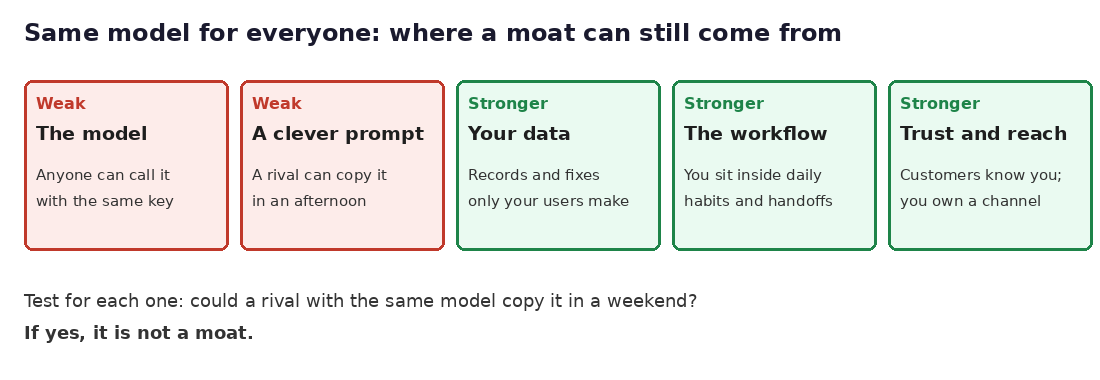
The model itself. If your pitch is "we use the best model," you have no pitch. The best model today can be called by anyone tomorrow, and models change often. The lesson Choosing Models: Big, Small, Open, Closed in the course The AI Product Stack covers how to pick one for the job. Picking well helps your costs. It does not protect you.
A clever prompt. A good prompt is real work, and it still reads as plain text. A user can paste it into a chat window, and a rival can rewrite it in an afternoon. Treat the prompt as a recipe on the menu, not a secret in the vault.
A thin layer of interface. A nicer box around the same answer is easy to copy. The post Is my AI startup just a thin wrapper around ChatGPT? gives a way to check whether your product is more than that.
Being first. Speed to launch is useful for learning. It is a weak defence, because a copy can be built quickly when the hard part is a model call.
Your own data, the first moat that can last
Data is a moat only when it is data a rival cannot get. Public web pages do not count, because anyone can use them. What counts is information your product collects because people use it: their corrections, their approvals, their saved preferences, the outcomes that followed a suggestion.
Each time a user fixes an answer, your product learns what "right" looks like in that setting. Over months you hold a set of examples no newcomer has. You can use it to test new models, to guide prompts, and to build features a generic tool cannot match.
Be honest about the limits. Data is a moat only if it keeps growing as you grow, and only if you have the right to use it. Check what you tell users about how you handle their information before you plan around it.
Workflow position: being where the work already happens
A second moat comes from where your product sits in a customer's day. If it plugs into their files, their team handoffs and their habits, switching means more than trying a new website. It means retraining people and redoing set-up.
A general chat assistant is a place people go to ask questions. A workflow product is a place work passes through. A tool that reads the invoice, drafts the reminder, sends it from the right address and records the reply is part of how the business runs. That position is hard to copy because it was built one integration and one habit at a time.
This moat takes patience. It also fits the advice in How to Get Your First 10 Customers for a New Product: serve a few customers closely enough to learn how their work really runs.
Trust, brand and reach
The third group is about people, not systems. If customers know you and believe you, a rival must win that belief first. Trust comes from being correct, being clear about what your product can and cannot do, and fixing mistakes quickly.
Reach is the other half: a way to get in front of customers that your rivals lack. That might be a community you already belong to, a partner who sends you users, or an audience you built by teaching. The post How to Find the Right Distribution Channel for a Startup shows how to pick a channel and test it. The course Distribution and Moats pairs its moat lesson with a lesson on getting in front of customers, because the two work together.
A worked example: three invoice reminder tools
The numbers and names here are invented to show the reasoning. They are not research and they are not real companies.
Three small teams each build a tool that writes polite payment reminders for freelancers. All three call the same model.
- Tool A offers a text box. You paste an overdue invoice and it writes a message. Moat score: close to zero. A user can do the same in a chat window.
- Tool B connects to the freelancer's accounting software, sends reminders on a schedule, and learns which wording gets paid fastest for each client. The freelancer's edits teach it their tone. Moat: workflow position and the data from edits.
- Tool C is run by a founder who writes for freelancers every week and is known in two freelancer communities. The product is like Tool A, but people already trust the founder. Moat: reach and trust.
Now suppose a well-funded rival launches a copy of all three in one weekend. Tool A loses its users, because there was nothing to keep them. Tool B holds, because moving means reconnecting accounts and losing the learned wording. Tool C holds for a while, but it needs to add some workflow or data to stay safe once the rival builds its own audience.
The lesson is not that one moat wins. It is that Tool A had none, and the other two each had a real one that could grow.
The weekend copy test
You can check your own idea with one question for each claimed advantage: could a rival with the same model copy this in a weekend?
- Write down your three biggest reasons a customer picks you over a free chat assistant.
- For each, answer the weekend question honestly. "Yes" means it is not a moat.
- For the ones that survive, ask whether they grow with use. A moat that stays the same size is only a head start.
- Name one thing you can do this month to deepen the best one: connect a new system, collect a new kind of correction, or reach a new group of customers.
If nothing survives step two, that is useful news. It is far cheaper to learn it before you build than after. Go back to talking to customers and look for a problem where one of the stronger moats is possible. Risk matters too: the lesson Building on Someone Else's Model is about what happens when a business depends on a model you do not control, and the post on how an AI API call is billed shows why your costs depend on that supplier too.
Frequently asked questions
Is a good prompt a moat?
Rarely. A prompt is text that a user or rival can copy or rewrite. It is worth refining, but do not build a business plan that depends on it staying secret.
Do I need a lot of data to have a moat?
No. You need data that is hard for others to get and that grows as people use the product. A small set of expert corrections in a narrow field can matter more than a large pile of public text.
Can a solo founder build a moat?
Yes. Trust, a niche audience and a close fit with a few customers' workflow are all things a single person can build. They take time more than money.
Does the choice of model matter for a moat?
It matters for cost and quality, but it is not a moat on its own. Other builders can switch to the same model or a better one at any time.
Get started
The Intermediate course Distribution and Moats covers how customers actually find you, what still protects a business when anyone can call the same model, and the risk of building on someone else's platform. It is three short, hands-on lessons.
Every lesson is free. Start learning with AI Entrepreneur: sign in on the home page and take your first short lesson today.