Why AI Is a Platform Shift Like the PC, Web and Mobile
Why AI is a platform shift like the PC, web and mobile: each made something expensive cheap. See the pattern, where AI differs, and a 20-minute exercise.
If you want to know why AI is a platform shift like the PC, web and mobile, start with one question: what used to be expensive, and is now cheap? Each big shift in computing answered that question in its own way, and each answer opened room for new companies. This post walks through the pattern, shows where AI fits it, says where the comparison gets weak, and ends with a short exercise you can run on your own idea.
What a platform shift is
A platform is the base other products get built on. A platform shift happens when a new base appears and a whole class of products becomes possible, cheaper to make, or both.
It is not the same as a trend. A trend gets talked about. A shift changes what it costs to build, reach or serve something, and that change lasts. The AI Entrepreneur course Platform Shifts and the Founders Who Rode Them puts it this way: PCs, the internet, cloud and mobile each made something expensive cheap, and each minted a new generation of companies.
That framing gives you something to measure. You do not have to argue about whether AI is "big". You can ask what got cheaper, and who can now do something they could not do before.
The pattern: something expensive gets cheap
Marc Andreessen made this argument in "Why Software Is Eating the World", published in 2011. Read it on a16z.com; it is his view, not a settled fact, and it is worth reading in full. Three of his points show the pattern clearly.
- Starting got cheap. He wrote that running a basic internet application once cost about $150,000 a month, and that the same application in Amazon's cloud cost about $1,500 a month at the time he wrote.
- Reach got large. He wrote that over two billion people used broadband internet, up from perhaps 50 million a decade earlier.
- Mobile put a computer in pockets. He expected at least five billion people to own smartphones within ten years.
The shape repeats. Something scarce becomes plentiful. People who were locked out can now build. A new set of companies appears that would not have made sense under the old costs. The lesson The Collapse in the Cost of Starting in the same course is about the cost side of this story.
Why AI is a platform shift
Now ask the same question of AI. What got cheap?
The short answer is certain kinds of language work: drafting, summarizing, sorting, answering questions, turning messy text into something structured. A task that needed a person reading and writing can now be attempted by a model for the cost of a request. The lesson Why AI Is a Platform Shift makes this case. It is the last lesson of the platform-shifts course, after the lessons on past shifts.
Understanding the mechanism helps you avoid over-reading the comparison. A language model predicts the next piece of text, one token at a time. We explain that in how large language models work.
Check the pattern against it:
- Something scarce became plentiful: language work on demand.
- People who were locked out can now build. The course Your First Builds: Simple Projects moves from no code to a little code, with a landing page, a prompt-powered micro tool and an automated workflow.
- Some product ideas now make sense that did not before, because the thinking step got cheaper.
That is the argument. It is not a promise of any outcome. It is a way to see where an opening might be.
Where AI is different from earlier shifts
The pattern holds, but AI is not a copy of the earlier shifts. Three differences matter to a builder, and each has a lesson in the app.
Every request has a cost
With much software, one more user costs almost nothing. With an AI product, each request uses a model and you pay for it. The lesson Model APIs, Tokens and What a Request Costs covers this. It changes how you price: a flat fee plus heavy users can mean a loss on each one. We work through it in how to price an AI product without losing money per user.
The output can be wrong
A spreadsheet adds up the numbers you give it. A model writes a plausible answer, and sometimes that answer is mistaken. The course How Modern AI Actually Works covers the limits every builder must design around, and its lesson What AI Gets Wrong is about them. You cannot judge quality by eye forever. That is why the advanced course on evals exists, and why we wrote about LLM evals.
Everyone can call the same model
If anyone can use the same model, a good prompt on top of it is easy to copy. The course Distribution and Moats asks what still protects a business when AI is cheap, and covers the risk of building on someone else's model in a lesson of that name. Earlier shifts had platform risk too. Here the layer you depend on can change often and sits close to the core of your product.
A 20-minute exercise to find your opening
Here is a worked exercise. It takes about twenty minutes and a notebook, and it uses the same question as the shifts above.
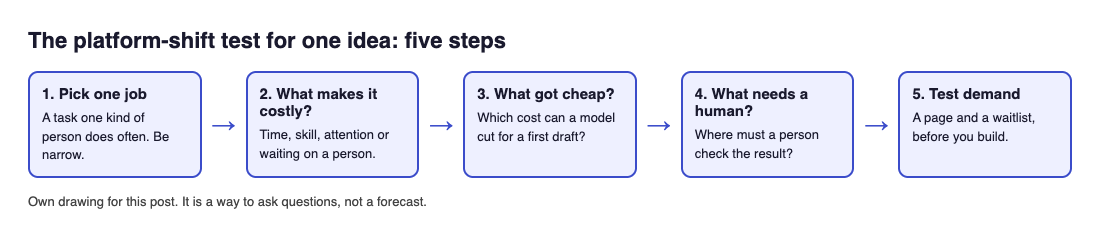
- Pick one job. Choose a task one kind of person does often, such as a bookkeeper sorting invoices or a recruiter screening applications. Be narrow.
- Write what makes it costly today. Is it time, skill, attention, or waiting on a person?
- Ask what got cheap. Which of those costs could a model cut? Finish this sentence: "This used to need ___, and now a model can do a first pass."
- Name what still needs a human. Models can be wrong, so say where a person must check the result.
- Test demand before you build. Put the idea on a page and see if anyone asks for it. Our post on testing demand with a landing page and a waitlist shows how.
You can hand step three to an assistant. Try a prompt like this:
I want to understand one job: [job] done by [type of person]. List its steps. For each step, say what makes it slow or costly today, whether a language model could plausibly write a first draft, and what could go wrong if it does.
Treat the answer as a list of questions for real people, not as facts. The lesson Talking to Customers Without Fooling Yourself is about that step.
Then ask whether your idea is a thin wrapper or a real product. We cover that in is my AI startup just a thin wrapper around ChatGPT.
Signs the comparison breaks down
An analogy is a tool, not a law. Use it to ask better questions, and watch for signs that it fails.
- Costs may not fall for you. If your cost per request stays high for your use case, the "cheap" part of the story is weaker for you.
- Quality may not be good enough. If the model is wrong too often and you cannot check it cheaply, the job may not be ready.
- You may have no edge. If a competitor can copy your product using the same model, ask what protects you.
- The platform may change under you. A model provider can change behavior or terms. Plan for that.
- People disagree. Some cards in the lessons set out where researchers disagree, and every lesson lists its sources. Read them instead of taking anyone's forecast, ours included, on trust.
Learning about a shift is also not the same as building a business. AI Entrepreneur teaches. It does not build, launch or run anything for you, and it gives no personal legal, tax or investment advice. Nothing here promises income or results.
Frequently asked questions
Is AI really a platform shift or just a trend?
The test is whether it made something expensive cheap in a lasting way. The lesson Why AI Is a Platform Shift argues that it did, and you should read its sources and decide for yourself.
What did the PC, web and mobile have in common?
Each one made something costly cheap, and each brought a new generation of companies. That repeated shape is the pattern to look for.
How is AI different from earlier shifts?
Each request has a real cost, outputs can be wrong, and many builders can use the same model. Those three facts change how you price, test and defend a product.
Do I need to code to take advantage of it?
Not to start. The course on first builds moves from no code to a little code, with a landing page, a prompt-powered micro tool and an automated workflow.
Get started
AI Entrepreneur has 12 courses and 36 lessons, about 6 hours in all, and each lesson takes 8 to 12 minutes. The platform-shifts course is at the Basic level, so you need no background. Every lesson is free. Start learning with AI Entrepreneur: sign in on the home page with a 6-digit code sent to your email and take your first short lesson today.