A Short History of AI From Turing to ChatGPT
A short history of AI from Turing in 1950 to ChatGPT in 2022: the winters, the deep learning breakthrough, the transformer, and what each step teaches a founder.
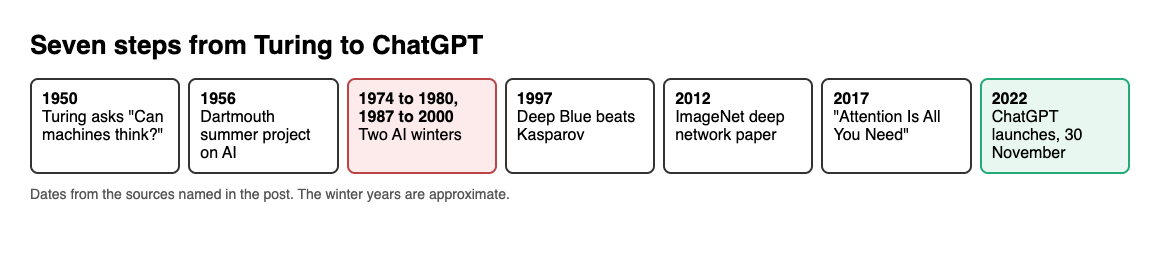
If you want a short history of AI from Turing to ChatGPT, it fits in one sitting. It runs about seventy years, in three big steps: early thinking machines and the winters that followed, the deep learning breakthrough, and the transformers and scale that led to ChatGPT. This post walks through each step and ends with what it means if you plan to build something with AI.
A short history of AI from Turing to ChatGPT: why it matters for founders
You can build with AI without knowing any of this. But the history gives you a pattern, and the pattern is useful. Big claims arrive early, the technology lags and money dries up, and later a technical change moves things again.
If you know that cycle, you can judge a new tool, a new funding wave or a new promise with a cooler head.
The first course in AI Entrepreneur, The Road to the Age of AI, covers exactly this arc in three short lessons. This post is the quick version.
1950: Alan Turing asks whether machines can think
In 1950 the British mathematician Alan Turing published a paper called "Computing Machinery and Intelligence". It opens with the question "Can machines think?" Instead of arguing about the word "thinking", Turing replaced the question with a game. A judge asks written questions of two hidden players. Turing then asks what happens when a machine takes one player's place, and whether the judge is wrong as often as with two people.
You do not need to treat the Turing test as a scientific standard. What matters is the move he made: replace a vague philosophical question with something you can try. That habit, testing behavior instead of debating definitions, is still how good AI products get judged. It is the same idea behind LLM evals.
1956: Dartmouth and the birth of artificial intelligence
In the summer of 1956, a small group of researchers met at Dartmouth College. Its name was the Dartmouth Summer Research Project on Artificial Intelligence, and John McCarthy wrote the proposal. Dartmouth's own history page says the gathering marked the birth of AI as a research field. The proposal's bet was bold: that every aspect of learning, or any other feature of intelligence, could in principle be described precisely enough for a machine to simulate it.
The goals were large, and the results fell short of them. That gap is the start of the next part of the story.
The AI winters: when hype outran the technology
An AI winter is "a period of reduced funding and interest in AI research", in the words of the Wikipedia article on the term. It lists two major ones, roughly 1974 to 1980 and 1987 to 2000. The first followed criticism of AI's unmet goals and funding cuts in the UK and the US. The details differ, but the shape is the same.
- Researchers make big promises.
- The systems fall short on real problems.
- Money and attention leave.
For a founder, the lesson is not "AI always disappoints". The lesson is that a promise is not a product. A system that works in a controlled setting can still fail when real users throw real inputs at it. The same warning sits behind the question in whether your AI startup is just a thin wrapper: a flashy front end does not prove there is a durable business underneath.
The 1980s to 2000s: expert systems, machine learning and Deep Blue
After the first disappointments, the field kept going in several directions at once.
Rules written by hand
One approach was the expert system: a program full of if-then rules written down by human specialists. According to the same Wikipedia article, companies spent over a billion dollars on them by 1985, and by the early 1990s they had proved costly to maintain, brittle and unable to learn. The second winter was tied to that.
Learning from examples
Another approach was machine learning. Instead of writing the rules, you give a program many examples and let it find patterns itself. This shift, from "tell the machine what to do" to "show the machine and let it learn", is the most important idea in the whole story. Everything after this builds on it.
Deep Blue
In May 1997, IBM's Deep Blue beat the reigning world chess champion Garry Kasparov 3.5 to 2.5 in a six-game match in New York, according to IBM's history page. It was a landmark for one game. A chess machine is not a machine that does everything, so the win did not end the debate about general intelligence.
2012: Deep learning and the ImageNet breakthrough
The next big step came from three things arriving together: much more data, much faster chips, and neural networks with many layers, which is what "deep" refers to.
In 2012, Alex Krizhevsky, Ilya Sutskever and Geoffrey Hinton published "ImageNet Classification with Deep Convolutional Neural Networks". Their network sorted 1.3 million images into 1,000 classes, and the paper reports error rates it calls "considerably better than the previous state-of-the-art results".
Notice the ingredients. The app's course on this period names data, chips and deep learning. Treat the link to cost as a pattern, not a proof: when something expensive becomes cheap, new companies tend to appear. It is also the core of the argument in why AI is a platform shift like the PC, web and mobile.
2017: The Transformer paper and the road to large language models
In June 2017, eight authors posted a paper titled "Attention Is All You Need". It describes the transformer, a design "based solely on attention mechanisms, dispensing with recurrence and convolutions entirely". The authors argue it is easier to run in parallel and faster to train, with better translation quality than earlier models.
That design is the base of today's large language models, and the "scale" part of the story is training them bigger on more text.
At heart, a language model is trained to predict the next piece of text given the text before it. That sounds almost too simple, yet it is the engine behind the assistants you use. If you want the plain explanation, read how large language models work.
2022: ChatGPT brings AI to everyone
OpenAI launched ChatGPT on 30 November 2022. It is built on a generative pre-trained transformer, fine-tuned for conversation using supervised learning and reinforcement learning from human feedback. What changed for most people was access: a raw model had become a helpful assistant you could talk to.
That is the difference between a research result and a platform. Once ordinary people can try a capability themselves, builders start asking what they can make with it. Builders then started asking what to make on top of models they did not train.
What this history teaches AI entrepreneurs
Here are the practical takeaways, in plain terms.
- Hype cycles are normal. Treat every bold prediction, including today's, as a claim to test, not a fact.
- Cost drops create openings. Deep learning took off with more data and faster chips. Look for what has just become cheap in your field.
- Access beats invention. The transformer was published in 2017, and ChatGPT put the idea in front of ordinary people in 2022. Distribution and usability decide who benefits.
- Demos are not products. The winters followed promises the systems could not keep. Measure quality on real inputs.
- Limits stay. Modern models still get things wrong, so you design around that.
A small exercise
Pick the product idea you are thinking about and write three lines. This takes about ten minutes.
- What has recently become cheap or easy that makes this idea possible now?
- What would a flashy demo of this idea look like, and what real input would break it?
- How would I check that it works for a real person, not only for me?
If you cannot answer the second and third lines, you have found the work to do before building more. When you are ready to plan beyond that, the roadmap from side project to AI company gives you an order to follow.
Frequently asked questions
When did the history of AI begin?
Most accounts start with Alan Turing's 1950 paper "Computing Machinery and Intelligence", followed by the 1956 Dartmouth summer project on artificial intelligence. Ideas about thinking machines are older, but these two events are common starting points.
What is an AI winter?
An AI winter is a period of reduced funding and interest in AI research. Two major ones are dated roughly 1974 to 1980 and 1987 to 2000.
What made ChatGPT possible?
Deep learning, the 2017 transformer design and training on large amounts of text came first. ChatGPT, launched in November 2022, then fine-tuned a language model for conversation so anyone could use it.
Do I need to know this history to build an AI business?
No, but it helps you spot hype, see why costs matter, and avoid mistaking a demo for a product. It is background that sharpens your judgment.
Get started
The three lessons in The Road to the Age of AI cover this history in short, hands-on steps: Thinking Machines (Turing to the AI winters), Data, Chips and the Deep Learning Breakthrough, and Transformers, Scale and ChatGPT. Each lesson lists its sources, so you can read the original work yourself.
Every lesson is free. Start learning with AI Entrepreneur: sign in on the home page with a 6-digit code sent to your email and take your first short lesson today.