Customer Lifetime Value and Churn: How to Calculate Both
Learn how to calculate customer lifetime value and churn for a subscription, with a worked example that shows why small changes in churn decide profit.
Customer lifetime value and churn are two numbers that decide whether a subscription business can last. Lifetime value tells you how much margin a customer brings before they leave. Churn tells you how fast they leave. This guide shows how to calculate both with a worked example you can copy, and what to do when the result looks bad.
It builds on the guide to unit economics, which defines the basic terms. Here we go one step further and look at time: how long a customer stays.
What customer lifetime value means
Customer lifetime value (LTV) is the total margin one customer brings you between the day they start and the day they leave. Note the word margin. If a customer pays you 20 dollars a month and it costs you $8 to serve them, they bring 12 dollars a month, not $20. Counting revenue instead of margin is the most common way to fool yourself.
LTV matters because it sets a ceiling on what you can spend to win a customer. If a customer is worth $120 in margin over their life, paying $300 to win them loses money every time.
What churn is and how to measure it
Churn is the share of customers who leave in a period. Monthly churn of 10% means that out of every 100 customers you have at the start of a month, about 10 are gone by the end of it.
To measure it, pick a period and count:
- Customers at the start of the month.
- How many of those customers left during the month.
- Divide the second number by the first.
Do not count customers who joined during the month in the first number. They have not had a full month to leave yet. If you start a month with 200 customers and 18 of them cancel, your monthly churn is 9%.
How to calculate customer lifetime value and churn together
The two numbers are linked. If a steady share of customers leaves every month, the average customer stays for one divided by that share. At 10% monthly churn, the average life is 1 / 0.10 = 10 months. At 5% it is 20 months.
That gives the simple formula most founders start with:
- Monthly margin per customer = monthly price minus the monthly cost of serving them.
- Average life in months = 1 divided by monthly churn.
- Lifetime value = monthly margin multiplied by average life.
This is a rough model. It assumes the share of customers who leave stays the same every month, and real customers rarely behave that neatly. But it is good enough to compare choices and spot a business that cannot work.
A worked example with invented numbers
Suppose you sell an AI tool that checks resumes for a subscription of 20 dollars a month. Every number below is invented for the example. It is not data from a real product.
- Each customer uses the model, which costs you about 8 dollars a month in API calls and hosting. Monthly margin is $20 - $8 = $12.
- You track 100 customers over a month and 10 cancel. Monthly churn is 10%, so the average life is 10 months.
- Lifetime value is $12 x 10 = $120.
- You paid $90 in ads and time for each customer you won. That is your customer acquisition cost (CAC).
The customer is worth $120 and cost $90 to win, so you keep $30 per customer. It works, but only just. Now see what churn does to the same product.
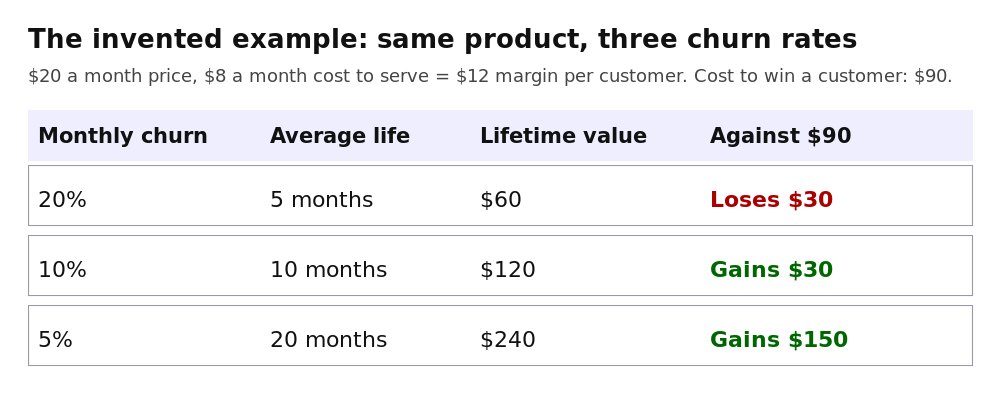
At 20% churn the average life is 5 months and lifetime value drops to $60, below the $90 you spent. You lose $30 on every customer. At 5% churn the life is 20 months, the value is $240, and you keep $150 per customer. Nothing changed about the price or the cost. Only the time customers stayed changed.
Why churn matters more for AI products
Many AI products have a real cost on every use, because each request to a model costs money. That makes margin per customer smaller and less predictable than in older software, so the margin number in your formula needs care. A heavy user can cost far more than a light one, and a plan that averages 8 dollars a month in cost may hide customers who cost $30.
Churn is also easy to underestimate when a product is new. Early customers are often friendly people who found you on purpose. Later customers arrive from colder sources and may leave faster, so check your churn again as you grow. The lesson Revenue, Costs and Unit Economics in the Business Basics for Builders course is about how these numbers fit together.
How to improve lifetime value without raising prices
You have two levers: raise the margin or lengthen the life. Churn is usually the better place to look first, because small gains compound over a long time.
- Find out why people leave. Ask every customer who cancels for one reason, in one question. Patterns show up after a dozen answers.
- Help new customers get a first result fast. People who never get value in the first week tend to leave early.
- Cap your heaviest costs. A usage limit or a smaller model for simple jobs protects margin.
- Talk to customers. Handpicked early customers teach you more than a dashboard. How to get your first 10 customers shows how to win and learn from them one by one.
Before you tune any of this, make sure the product is small enough to learn from. What an MVP is and how small version one should be explains how to ship something you can measure.
Mistakes to avoid
- Using revenue instead of margin in the formula.
- Counting new customers in the churn calculation.
- Trusting one month of data. With 20 customers, one cancellation moves churn by 5 points.
- Mixing very different customers into one average. A free-trial user and a long-term user are not the same.
- Forgetting that growth is its own number. See the lesson Growth: The Number a Startup Lives By, which sits in the same course.
Frequently asked questions
What is a good churn rate?
There is no single answer, because it depends on the product, the customer and the price. Compare your churn with your own earlier months and with your CAC, not with a number from someone else's business.
Is customer lifetime value the same as revenue per customer?
No. Lifetime value uses margin, which is revenue minus what it costs to serve the customer. Revenue alone overstates what you keep.
How many customers do I need to measure churn?
The more the better. With a small number, one customer leaving moves the result a lot, so treat early figures as rough and update them each month.
Does this formula work for a one-time purchase?
Not directly. The formula fits subscriptions, where customers pay again every month. For one-time purchases, look at repeat purchases instead.
Get started
Every lesson is free. Start learning with AI Entrepreneur: sign in on the home page with a 6-digit code sent to your email and take your first short lesson today. You can read what the app is on the About page.