Difference Between Revenue and Profit for a Startup
Learn the difference between revenue and profit for a startup, how to calculate each, and why AI founders must track margins, burn, and runway, not just sales.
If you are asking what is the difference between revenue and profit for a startup, the short version is this: revenue is the money customers pay you, and profit is what is left after you pay for everything. A startup can have a lot of one and none of the other. Knowing which number you are looking at keeps you from fooling yourself. The lesson Revenue, Costs and Unit Economics in the free AI Entrepreneur course Business Basics for Builders covers the same ground in short, hands-on lessons.
What is the difference between revenue and profit for a startup? The short answer
Revenue is the top line. It is the total your customers pay for your product in a period. Profit is the bottom line. It is revenue minus costs.
Here is the whole idea in one line:
Profit = revenue minus costs.
Revenue tells you whether people will pay. Profit tells you whether the business can keep going on what they pay. Both matter, but they answer different questions.
What revenue means for a startup (MRR, ARR, and bookings)
Subscription startups use a few revenue terms. They sound similar, so keep them apart.
- MRR is monthly recurring revenue. It is what your subscriptions bring in each month. Forty customers at $25 a month is $1,000 MRR.
- ARR is annual recurring revenue. A simple way to get it is MRR times 12. $1,000 MRR is $12,000 ARR.
- Bookings is the value of deals customers have signed. A customer who signs a $240 annual plan is $240 in bookings on day one, even though you will earn that revenue month by month.
Revenue is also not the same as cash in your bank. A customer might prepay for a year, or a client might pay you late. Cash timing matters when you plan, so keep it in mind when you read any revenue number.
What profit means: gross profit, operating profit, and net profit
"Profit" is not one number. You will meet three versions, each taking away more cost.
Gross profit
Gross profit is revenue minus the direct cost of serving customers. For a software product that includes hosting and payment fees. For an AI product it also includes what you pay for each model request. Divide gross profit by revenue and you get gross margin.
Operating profit
Operating profit is gross profit minus the cost of running the company: salaries, marketing, tools and so on. It shows whether the business itself makes money, before taxes and other items.
Net profit
Net profit is what remains after every cost, including taxes. This is the true bottom line. If it is negative, you have a net loss.
For personal tax or accounting questions, talk to a qualified professional. AI Entrepreneur teaches the concepts and does not give personal legal, tax or investment advice.
A worked example with real numbers
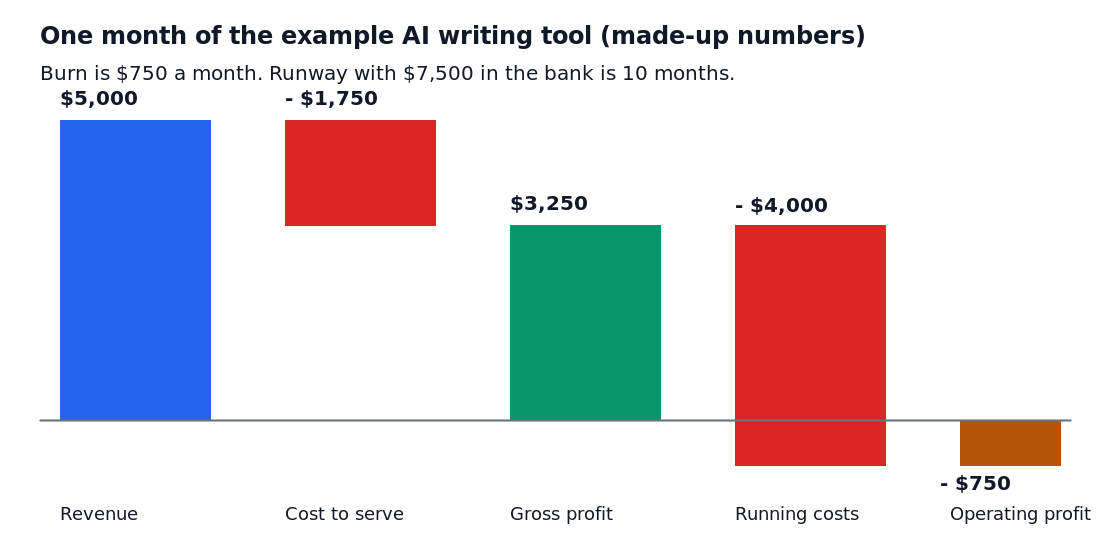
These numbers are made up to show the mechanics. Say you run a small AI writing tool.
- Customers: 200, each paying $25 a month.
- Revenue: 200 x $25 = $5,000 a month (that is MRR). ARR is $60,000.
- Cost of serving customers: $1,500 in model API fees plus $250 in hosting and payment fees, so $1,750.
- Gross profit: $5,000 minus $1,750 = $3,250. Gross margin is 3,250 / 5,000 = 65%.
- Running costs: $2,500 for your pay, $1,000 for marketing and $500 for tools, so $4,000.
- Operating profit: $3,250 minus $4,000 = minus $750.
With no taxes owed, net profit is also minus $750. This business has $5,000 of revenue and loses $750 every month.
That monthly loss is your burn. If you have $7,500 in the bank, your runway is $7,500 / $750 = 10 months. After that you need to raise margin, grow revenue, cut costs or find money. Running the same sums on your own numbers is the quickest way to make this concrete.
Why high revenue can still mean a failing startup
Revenue is easy to celebrate and easy to buy. You can grow it by selling below cost, spending heavily on ads, or giving away extras. The line goes up and the company still loses money.
Three patterns cause most of the trouble:
- Each customer costs more than they pay. If serving a customer costs $50 a month and they pay $25, every new customer deepens the loss. More revenue makes it worse.
- Acquiring customers costs too much. If winning a customer costs more than the gross profit they bring in over their time with you, growth drains cash.
- Customers leave quickly. Revenue you must keep replacing is expensive revenue.
This is why the same course teaches costs and unit economics right after problems worth paying for. The unit question is simple: does one customer, on their own, make you money? If not, scaling does not fix it.
Growth still matters a great deal. The lesson Growth: The Number a Startup Lives By covers it, and our post on what weekly growth rate an early startup should aim for goes deeper. Growth is worth chasing when each unit of it is healthy.
Why AI startups have unusual margins (inference and API costs)
A traditional software product costs little to serve once it is built. An extra user adds close to nothing. An AI product is different, because every request to a model has a price. The course The AI Product Stack has a lesson called Model APIs, Tokens and What a Request Costs for exactly this reason.
The practical effects:
- Your cost of goods grows with usage. A customer who uses the product ten times more can cost you far more, while paying the same flat price.
- Heavy users can be unprofitable. A flat monthly plan averages out across users, but a few very active ones can eat the margin.
- Your model choice sets your margin. A larger model may give better answers and cost more per request. Our post on choosing between open and closed AI models helps you weigh that choice.
- Pricing has to account for cost. The lesson Pricing AI Products, in the course Launch, Price and Get Paid, is about pricing without losing money on every user.
A simple habit helps. Before you set a price, estimate what one typical customer costs you in model requests each month. Then estimate what your heaviest customer costs. If the heavy case is above the price, you have found a margin problem before a customer found it for you. Once you are live, monitoring an AI product in production keeps you watching what real usage looks like.
Margin is also tied to whether your product is worth paying for at all. If your product is a light layer on top of someone else's model, customers may have little reason to stay, and little reason to pay more. Read is my AI startup just a thin wrapper around ChatGPT to test that.
Which metric to track at each stage: revenue, profit, burn, and runway
You do not need every number from day one. Match the metric to where you are.
Before you have customers
Revenue is zero, so track proof that people will pay. Interviews, a waitlist and a first paid pilot are stronger signals than a spreadsheet of guesses. Estimate cost to serve early so you know what a customer will cost.
With your first paying customers
Track revenue and gross margin together. Revenue shows demand. Gross margin shows whether the product can make money at all. If you win those first customers by hand, note how you found them, since finding the right distribution channel shapes your acquisition cost later.
While you are still losing money
Track burn and runway. An early startup often loses money for a while, so the question is how long you can last. Runway is cash divided by monthly net burn. Check it every month.
When the business is steadier
Track operating and net profit. Now the question is whether the company pays for itself. Revenue growth and margin should both be moving the right way.
At every stage, keep revenue and profit side by side. One without the other is half a picture.
Frequently asked questions
Is revenue the same as profit?
No. Revenue is the money customers pay you. Profit is what is left after you subtract your costs.
Can a startup have high revenue and still lose money?
Yes. If serving and acquiring customers costs more than they pay, more revenue means a bigger loss. This is common when prices are low or usage costs are high.
What is gross margin?
Gross margin is gross profit divided by revenue. It shows how much of each dollar is left after the direct cost of serving customers. For an AI product, that cost includes model requests.
What is the difference between burn and runway?
Burn is how much money you lose each month. Runway is how many months you can last: your cash divided by your monthly burn.
Should an early startup focus on revenue or profit?
Early on, focus on proof that people pay and on healthy margin per customer. Full company profit usually comes later, but you should always know your burn and runway.
Get started
You can learn these ideas with short exercises instead of reading about them. Business Basics for Builders walks through revenue, costs and growth, and The AI Product Stack shows what a model request costs. Each lesson takes 8 to 12 minutes.
Every lesson is free. Start learning with AI Entrepreneur: sign in on the home page and take your first short lesson today.