Free Plan or Free Trial: Which Should Your Startup Offer?
Free plan or free trial? Work out what one free user costs you, how fast people see value, and which choice fits your AI product, with a worked example.
Free plan or free trial? It is one of the first pricing calls a founder makes. The better answer comes from three questions about your own product: what one free user costs you, how long a new user takes to see value, and whether free users bring in paying ones. This guide walks through each with a worked example for an AI tool. The numbers behind it, costs per user and pricing, are what AI Entrepreneur teaches in free, short lessons.
Free plan or free trial: the short answer
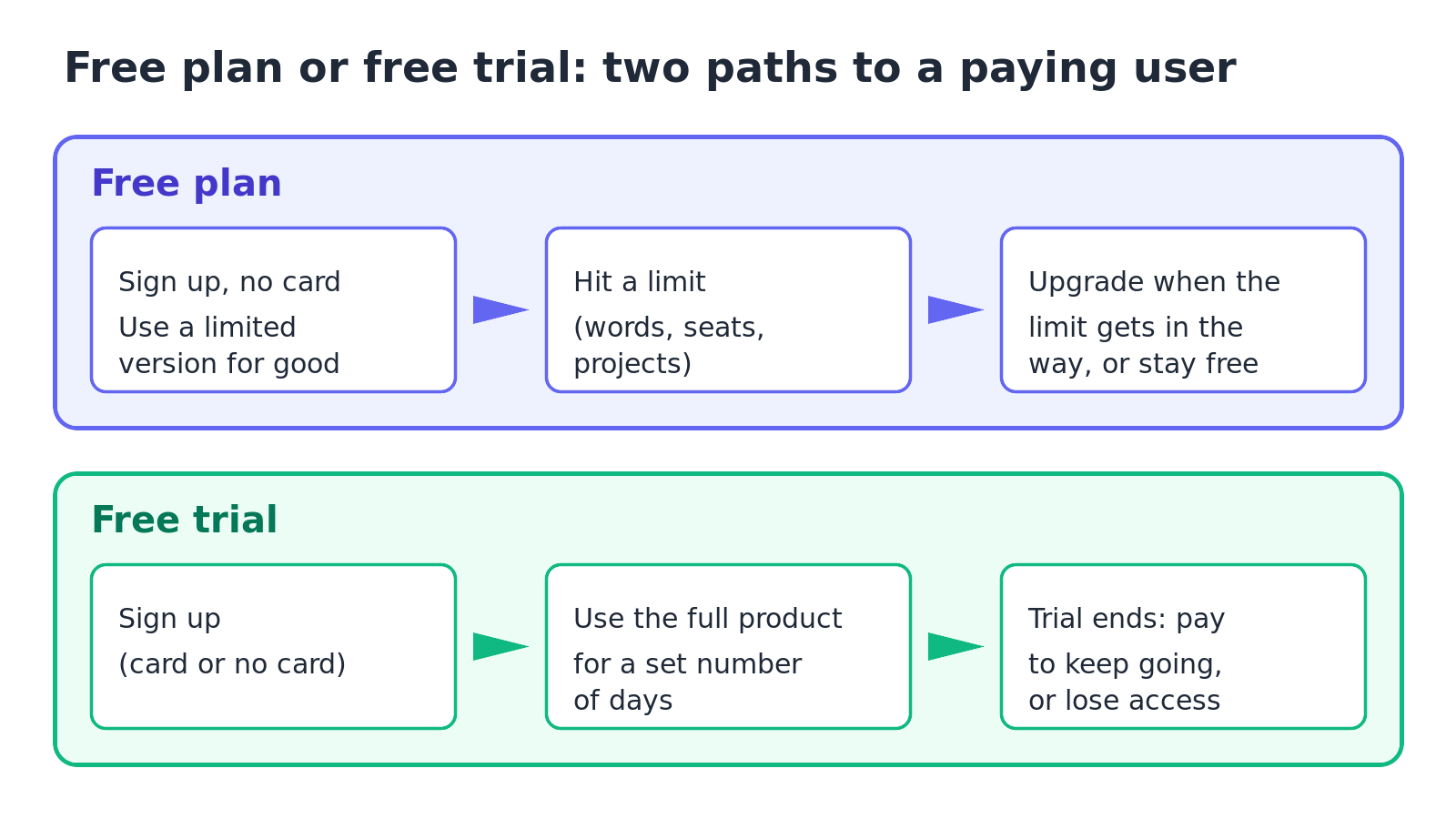
A free plan (often called freemium) lets people use a limited version of your product for as long as they like. A free trial gives people the full product for a set number of days. When the days run out, they pay or they stop.
- Pick a free plan when a free user costs you almost nothing, and free users bring in other users or paying teams.
- Pick a free trial when each user costs you real money to serve, or when your product only shows its value once someone uses all of it.
What a free plan actually costs you
A free plan is not free for you. Every free user brings three kinds of cost.
- Serving cost. Hosting, storage and, for AI products, model calls. It grows with every free user who stays active.
- Support cost. Free users email you, report bugs and ask questions. On a team of one, that time is the scarcest thing you have.
- Focus cost. Free users ask for features. If you build for them, you can end up with a product people like and do not pay for.
A free plan earns its place only if it gives you something back: word of mouth, a shared workspace that pulls in a team, or a steady flow of upgrades. If you cannot name what free users give you, the plan is just a cost line. Before you launch one, see how it moves your break-even point, because free users add costs without adding revenue.
What a free trial gives you instead
A trial has a deadline, and a deadline makes people decide. During the trial the user sees the full product. They reach a result that matters to them and pay, or they leave. Either way, you learn within weeks what makes people pay, where a free plan can keep someone around for months without a clear yes or no.
A trial also puts a ceiling on your costs, because nobody stays free forever. The price is reach: a product with a clock on it gets fewer people through the door, and someone who left after a trial is not using it in front of their friends.
Why AI products change the math
Classic software costs very little to serve one more user. AI products are different. Every request to a model costs money, and heavy users cost more than light ones. The AI Entrepreneur lesson Model APIs, Tokens and What a Request Costs shows how that cost is made up, and our post on pricing an AI product without losing money per user shows how to set a price above it.
Here is a worked example. The numbers are made up, so swap in your own.
- Your AI writing tool costs you about 1 cent in model fees for each request.
- An active free user makes 200 requests in a typical month. That is $2 of model fees for each free user.
- You have 1,000 active free users. That is $2,000 of model fees every month.
- Your paid plan is $20 for each month. You need 100 paying users just to cover what the free users cost, before rent, tools or your own pay.
Now change one input at a time. If free users send long documents, each request costs more, because you pay for every token in and out. If the plan were $40, you would need 50 paying users instead of 100. A free plan that looks harmless at 100 users can be the biggest line in your costs at 10,000.
You can ask an AI assistant to lay out the cases, with a prompt like this:
I run an AI tool. Each request costs me about 1 cent. Free users make between 20 and 400 requests in a month. My paid plan is $20 for each month. Build three cases (light, average and heavy free use) and tell me how many paying users I need in each to cover what free users cost. Show your working.
Check the arithmetic by hand before you trust it. Models get sums wrong, and a slipped zero here changes the whole decision.
Signs you should offer a free plan
- A free user costs you close to nothing. You can run the free version on cached results, a small cheap model, or no model at all.
- Your product spreads by use. Shared documents, invites or a visible badge mean each free user can bring in others.
- Value builds slowly. Some tools only get useful after weeks of stored data or habit, and a short trial would end before the user sees the point.
- There is a clear line between free and paid. Free users hit a limit that matters, such as team seats or exports, at the moment they get serious.
- You have the cash to wait. Free users pay nothing, so you carry their costs until enough of them upgrade.
Signs you should offer a free trial, and how long to make it
- Each user costs you real money. That is true of most AI products that call a large model.
- The product shines only in full. A cut-down free version would make it look worse than it is.
- You sell to businesses. A buyer with a budget usually wants to test the whole tool before signing off.
- You need to learn fast. Early on you want to know quickly whether people will pay, which fits the build, measure, learn loop behind a small first version.
How long? Time how long a new user takes to get their first real result, then leave room for them to get it again. If value shows up in one session, a short trial is enough. If your product works in weekly cycles, the trial has to cover at least one full cycle. A trial that ends before the user sees value only teaches people to leave.
Stripe's guide to free trials in Checkout gives a useful outside check. It allows trials of up to 2 years, but says most businesses use shorter ones, such as 30 days, and names two problems with long trials: cards that expire before the first charge, and lower conversion. The same guide shows that a trial does not have to take a card. Checkout collects one by default, but you can start a trial without it and choose whether the subscription cancels or pauses if no card is added by the end.
Middle paths: reverse trials, usage caps and credits
You do not have to pick one pure model. Three middle paths suit AI products in particular.
- Reverse trial. New users get the full paid product for a set period. When it ends, they drop to a limited free plan instead of losing access. Having felt the paid version, they notice its limits.
- Usage cap. The free plan is the full product with a monthly cap on requests, documents or minutes. Your worst case is known in advance: in the example above, a cap of 20 requests cuts each free user's cost to 20 cents.
- Credits. New users get a one-time pack of credits, and each action uses some up. Credits map straight onto your model costs.
Whichever you choose, treat it as an experiment: change one thing at a time and write down what you expect before you look.
Frequently asked questions
Do free trials convert better than free plans?
A trial asks every user to decide by a set date, so you should expect a larger share of trial users to pay. A free plan reaches more people, so it can still produce more paying users in total. Measure both against your own costs instead of trusting a general rule.
Should a free trial require a credit card?
Asking for a card filters out people who are only curious, which matters when every request costs you money. Leaving it out lowers the bar to start. Stripe's Checkout supports both, and without a card you choose whether the subscription cancels or pauses when the trial ends.
How long should a free trial be?
Long enough for a new user to reach their first real result and see it happen again. Stripe notes that most businesses use shorter trials, such as 30 days, and that long trials bring expired cards and lower conversion.
Can you switch from a free plan to a free trial later?
Yes, but do it with care. Give existing free users plenty of notice, or let them keep their plan, and apply the trial to new signups only.
Get started
The choice between a free plan and a free trial comes down to numbers you can work out yourself: what a user costs, how long they take to see value, and how fast you grow. AI Entrepreneur teaches those numbers in short, hands-on lessons. Start with Revenue, Costs and Unit Economics in the Basic course Business Basics for Builders, then Model APIs, Tokens and What a Request Costs and Pricing AI Products at the Intermediate level. Each lesson takes 8 to 12 minutes, asks questions that check your thinking, and lists its sources so you can read the original work.
Every lesson is free. Start learning with AI Entrepreneur: sign in on the home page and take your first short lesson today.