How to Calculate the Break-Even Point for a Small Business
How to calculate the break-even point for a small business: the formula, a worked example for a $29 monthly AI tool, and the levers that move it.
Every small business has a number of sales below which it loses money and above which it makes some. That number is the break-even point. If you want to calculate the break-even point for your own business, you need three inputs and one division: your fixed costs, your price, and the variable cost of each sale. This post shows the formula, works through a full example for a small AI tool, and then shows which levers move the number most. If you want short lessons on the numbers behind a business, AI Entrepreneur teaches them free, in lessons of 8 to 12 minutes.
What the break-even point means
The U.S. Small Business Administration describes the break-even point as the level of sales where total costs and total revenue are equal. At that point you make no profit and take no loss. One sale fewer and you are losing money. One sale more and you are making a little.
The idea is simple, but the number answers a question most founders guess at: how many customers do I actually need? Not how many would be nice, or how many would impress an investor. How many it takes for the business to pay its own bills each month.
Break-even is about profit, not cash. It tells you when the business stops losing money on paper. How long you can survive until then is a different number, your startup runway, and you need both.
The formula to calculate the break-even point
The SBA gives the standard formula for the break-even point in units:
Break-even units = fixed costs / (price per unit - variable cost per unit)
The part in brackets has its own name: the contribution margin. It is what each sale leaves over, after paying for itself, to cover the costs you pay no matter what. If you have read our post on unit economics, this is the same per-customer number. Break-even simply asks how many of those margins you need to stack up before the fixed costs are paid.
For a subscription business, a "unit" is one paying customer for one month. Price is the monthly price, variable cost is what it costs to serve one customer for a month, and fixed costs are your monthly overhead.
Sort your costs into fixed and variable first
Most mistakes come from putting a cost in the wrong pile. Use one test: if you had zero customers next month, would you still pay it?
- Fixed costs stay the same whether you have 10 customers or 200. Rent, software subscriptions, a contractor on a monthly retainer, insurance, an accountant, and your own pay if you take one.
- Variable costs rise with each customer. For an AI product the big one is usually the model provider's bill, because every request costs tokens. Card payment fees, support time per customer and any per-seat tool fees belong here too.
Some costs are a bit of both. Hosting often has a flat base plus usage on top. Split it: the base goes in fixed, the usage goes in variable. You do not need perfect accuracy. You need every cost in one pile, and none left out. The SBA makes the same point: working through a break-even analysis is a good way to catch expenses you forgot.
A worked example: a $29 monthly AI tool
Here is a made-up example you can copy with your own numbers. Say you sell an AI tool that drafts replies to customer emails for small online shops. Customers pay $29 for each month.
Step 1: variable cost per customer per month.
- Model API calls: $4
- Card payment fees: $1
- Support and email tools: $2
Total variable cost: $7 per customer.
Step 2: contribution margin. $29 - $7 = $22 per customer per month.
Step 3: fixed costs per month.
- Hosting base and software subscriptions: $400
- A part-time contractor: $1,500
- Accounting and insurance: $300
Total fixed costs: $2,200 a month.
Step 4: divide. $2,200 / $22 = 100 customers.
Check it. With 100 customers, revenue is 100 x $29 = $2,900. Costs are $2,200 fixed plus 100 x $7 = $700 variable, so $2,900. Revenue equals cost, exactly as the definition says.
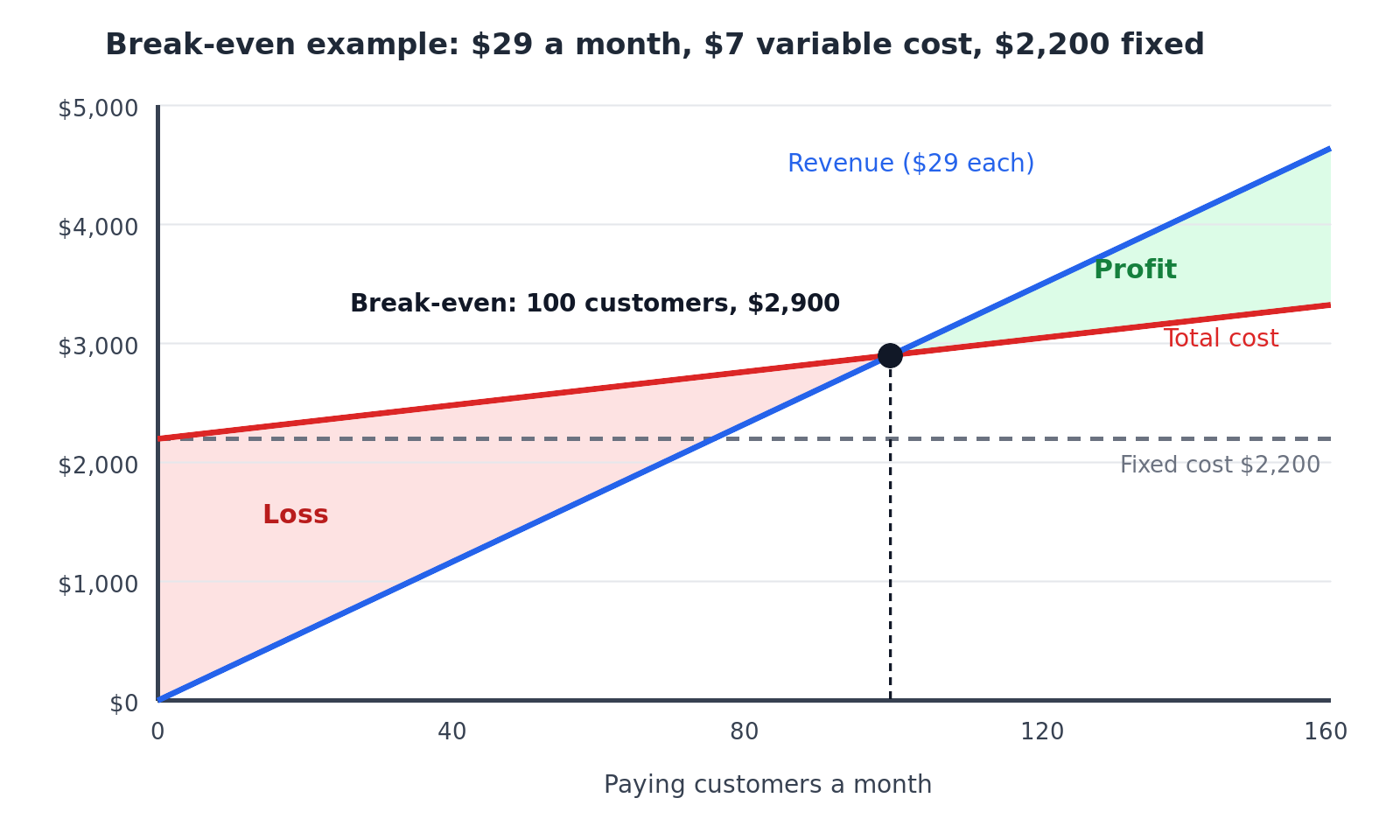
Now make it useful. Say you have 30 customers today. Your monthly loss is $2,200 - (30 x $22) = $1,540. If you add 10 customers a month, net of the ones who leave, you reach 100 in 7 months. That tells you how much cash you need to get there, and it turns a vague goal into a monthly target.
When the result is not a whole number, always round up. You cannot have 68.75 customers, and 68 would still leave you short.
Break-even in dollars, not just customers
Sometimes you want the answer as revenue, not a count. That is useful when you sell several products at different prices. Use the contribution margin ratio: the margin divided by the price.
In the example, $22 / $29 is about 0.759. So each dollar of sales leaves about 76 cents to cover fixed costs. Break-even revenue is $2,200 / 0.759, which is about $2,900 a month. That matches the 100-customer answer, which is a good sign your sums are right.
What moves the break-even point
The formula has three inputs, so there are three levers. Change one at a time in the example and watch what happens:
- Raise the price to $39. The margin becomes $32. $2,200 / $32 = 68.75, so 69 customers. A $10 price change cut the target by almost a third.
- Cut the model cost from $4 to $2, for example by sending easy requests to a cheaper model. The margin becomes $24, and the target is 91.67, so 92 customers.
- Pay yourself $3,000 a month. Fixed costs become $5,200, and the target is 236.36, so 237 customers.
- Drop the price to $19 to win more sign-ups. The margin falls to $12, and you now need 183.33, so 184 customers.
Two lessons fall out of this. First, price usually moves break-even more than cost-cutting does, because every dollar of price goes straight to the margin. That is why pricing an AI product deserves real thought. Second, a discount has to bring in far more customers to pay for itself: halving the margin roughly doubles the count you need.
For AI products, watch the variable cost closely. If heavy users run many more requests than light users, your average model cost can creep up as you grow, and your break-even point moves away from you. Measure cost per customer each month, not once.
Mistakes that make the number wrong
- Leaving out your own pay. A business that breaks even only because the founder works for free has not really broken even. Run the number both ways.
- Using revenue instead of margin. Dividing fixed costs by the price, not the margin, makes the target look smaller than it is. In the example it would say 76 customers instead of 100.
- Forgetting churn. Break-even counts paying customers this month. If 5% leave each month, you must keep winning new ones just to stay there.
- Treating it as a forecast. Break-even tells you the target. Whether you can reach it depends on how you find customers and what each one costs to win, which is your customer acquisition cost.
The SBA notes that lenders and investors usually expect to see a break-even analysis before they put money in. Even if you never raise money, it is the clearest single test of whether your prices and costs fit together. This post is general education, not personal tax or financial advice.
Frequently asked questions
What is the formula for the break-even point?
Break-even units equal fixed costs divided by the price per unit minus the variable cost per unit. For a subscription, a unit is one paying customer for one month.
Is break-even the same as being profitable?
Break-even is the point of zero profit and zero loss. Every sale past it adds profit, so it is the line you have to cross to become profitable.
Should I include my own salary in fixed costs?
Yes, at least in one version of the sum. Run it with and without your pay so you know both the survival number and the number where the business can support you.
How often should I recalculate it?
Recalculate whenever your price, costs or team change, and check it monthly for an AI product, since model costs per customer can drift as usage grows.
Get started
The break-even point is one division, but it rests on knowing your real costs and margins. In AI Entrepreneur, the Basic course Business Basics for Builders has a lesson on revenue, costs and unit economics. The AI Product Stack course covers what a model request costs, and Launch, Price and Get Paid covers pricing AI products. Questions include estimating a number, and every lesson lists its sources. You can read more on the About page.
Every lesson is free. Start learning with AI Entrepreneur: sign in on the home page with a code sent to your email and take your first short lesson today.