How to Find AI Startup Ideas That Solve a Real Problem
A step-by-step way to find AI startup ideas that solve a real problem: list painful problems, interview people, score ideas, check for a thin wrapper, then test demand.
If you want to know how to find AI startup ideas that solve a real problem, start by forgetting the model. The idea that lasts begins with a person who has a problem and is already trying to fix it. This guide gives you a step-by-step process, with a worked example at each step.
Why most AI startup ideas fail to solve a real problem
Most weak ideas start with a sentence like "What can I build with this new model?" That question begins with a tool and goes looking for a use. The result is often a demo people find clever and never pay for.
A real problem has three signs. Someone has it often. It costs them time or money. They are already doing something about it, even if that something is a spreadsheet or a long email thread. If you cannot point to a named person with all three, you have a guess, not an idea.
The app's course Business Basics for Builders is about the few numbers every founder must understand: who has the problem, what it costs to serve them, and how fast you are growing. Its lesson Problems Worth Paying For is the place to start on the first of those.
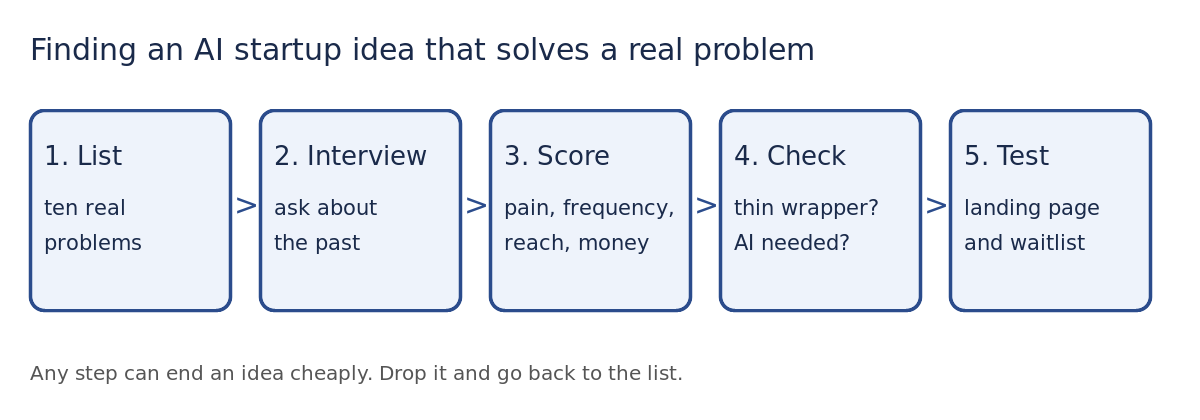
Start with painful problems, not with the technology
Write your idea as a problem statement, not a product description. Use this shape:
[Specific person] struggles with [specific task] every [time period], and it costs them [time or money].
Compare two versions.
- Technology first: "An AI assistant for small businesses."
- Problem first: "Owners of small dental clinics spend about an hour each morning replying to appointment requests by hand."
The second one is something you can check. You can find a dental clinic owner and ask whether it is true. The first one gives you nobody to call. The numbers in the second example are made up to show the shape, so replace them with what real people tell you.
How to find AI startup ideas: where to look for real problems
Good ideas rarely arrive from staring at a blank page. The lesson Where Good AI Ideas Come From in the Intermediate course Finding AI Opportunities is about this. Here are places to look that work in practice:
- Your own work. List the tasks you or your colleagues repeat each week that involve reading, writing, sorting or summarizing. You know these problems from the inside.
- Work that is boring and high volume. Think of tasks where a person reads many documents, messages or forms to produce a short result.
- Tasks done badly because they are tedious. If people skip a job because it is dull, a cheap tool that does it could add real value.
- Platform shifts. The course Platform Shifts and the Founders Who Rode Them is about how PCs, the internet, cloud and mobile each made something expensive cheap and minted a new generation of companies. Ask what AI has just made cheap, then ask who needs more of it.
Write down ten problems before you judge any of them. A list gives you something to compare. A single idea only gives you something to defend.
How to talk to potential customers and uncover pain
Talking to customers is the fastest way to learn whether a problem is real. It is also easy to do badly. If you describe your idea and ask "Would you use this?", most people will be polite and say yes. That answer tells you nothing.
The app's lesson Talking to Customers Without Fooling Yourself is about this trap. Here is a simple approach of our own: ask about the past, not the future.
- Ask when they last dealt with the problem. "Tell me about the last time you had to reply to appointment requests."
- Ask what they did. "What did you do first? What tools did you use?"
- Ask what it cost. "How long did that take? What happens when it goes wrong?"
- Ask what they have tried. "Have you looked for a fix? What did you try?"
- Do not pitch until the end, and listen more than you talk.
Strong signals are specific stories, existing workarounds and money or time already spent. Weak signals are compliments and vague interest. If five people describe the same painful task in their own words, you have found something worth examining further. For help finding those first people to talk to, see how to get your first 10 customers for a new product.
Score and filter your ideas before you build
After a round of interviews, you will have several candidates. Score each on a few questions, using a simple 1 to 5 scale:
- Pain: How much does this cost the person each time it happens?
- Frequency: How often does it happen?
- Reach: Can you find and contact people who have it?
- Money: Does the person or their company already spend money on this?
Add the scores and drop the bottom half. This is not science, but it forces you to compare ideas on the same terms. It also connects to the numbers in Business Basics for Builders, where the lesson Revenue, Costs and Unit Economics sits. If you later want to model what a customer is worth, customer lifetime value and churn shows how to calculate both.
Also ask how you would reach buyers. An idea with real pain but no obvious route to the customer is hard to start. How to find the right distribution channel for a startup goes deeper on that.
Check that AI is the right solution and not a thin wrapper
Once a problem looks real, ask two separate questions. Does this need AI? And if it does, is what you are building more than a thin layer on top of someone else's model?
The lesson Thin Wrapper or Real Product? is about the second question. A useful test is to imagine the customer typing your task into a general chat assistant themselves. If your product adds nothing they could not get that way, you are exposed. Value usually comes from things like your access to specific data, a workflow built into how the customer already works, or a result that is checked for quality. Our post Is my AI startup just a thin wrapper around ChatGPT? walks through this in detail.
Know the limits too. The lesson What AI Gets Wrong in the course How Modern AI Actually Works is about the limits every builder must design around. If your problem needs perfect accuracy every time, and a wrong answer is costly, you need a plan for checking the output. If you cannot design one, pick a different problem.
Finally, check the cost. Each request to a model API has a price, and it adds up per user. How much does an AI API call cost? explains token billing so you can estimate it before you commit.
Test demand with a cheap experiment before writing code
Interviews tell you the pain is real. An experiment tells you whether people will act. Run the smallest test you can.
The Intermediate course Your First Builds: Simple Projects starts with exactly this: Project 1: A Landing Page and a Waitlist. Here is a version of it:
- Write a one-page description of the problem and the result you offer.
- Add a clear way to join a waitlist.
- Send it to the people you interviewed and to places where your target customers gather.
- Count how many sign up, and talk to those who do.
For the dental clinic example, the page might say "Stop answering appointment requests by hand" and ask for an email. If nobody from your interview list joins, you learned something cheaply. The course Launch, Price and Get Paid is about shipping the smallest thing that teaches you something. A result like this guides what you do next, though it does not promise that a business will follow.
Frequently asked questions
How many ideas should I test at once?
Write down about ten problems, interview people about the best few, and run a demand test on one or two. Testing too many at once spreads your attention thin.
Do I need to know how to code to find a good AI startup idea?
No. Finding a real problem is about talking to people, not writing code. The three starter projects in Your First Builds run from no code to a little code, and the first one is a landing page and a waitlist.
How do I know if an idea is a thin wrapper?
Ask whether a customer could get the same result by typing your task into a general chat assistant. If yes, look for an advantage such as your own data, a built-in workflow or checked quality.
Can AI Entrepreneur tell me which idea will succeed?
No. It teaches the methods for finding and testing ideas. It does not build or run a business for you, and it cannot promise results.
Get started
The Intermediate course Finding AI Opportunities is about where good ideas come from, how to test them by talking to customers without fooling yourself, and how to avoid building a thin wrapper. It is three short, hands-on lessons.
Every lesson is free. Start learning with AI Entrepreneur: sign in on the home page and take your first short lesson today.