How to Validate a Business Idea With Customer Interviews
How to validate a business idea by talking to customers: who to interview, which questions to ask, how to tell real signals from polite praise, and what to do with the answers.
If you want to know how to validate a business idea, talk to the people who would pay for it before you build anything. Interviews are cheap, fast and honest, but only if you ask the right way. This guide shows you who to talk to, what to ask, and how to read the answers. If you are still choosing between ideas, start with AI Entrepreneur, a free set of short lessons on this, then come back here for the interview details.
How to validate a business idea: what it means
Validating an idea does not mean proving it will work. Nobody can do that with a few chats. It means finding out, as cheaply as you can, whether the problem is real, whether it hurts enough that people act, and whether they would pay to fix it.
The Intermediate course Finding AI Opportunities has a lesson on exactly this, called Talking to Customers Without Fooling Yourself. The phrase in the title is the whole challenge. The easiest person to fool in a customer interview is you.
Why asking "Would you use this?" fails
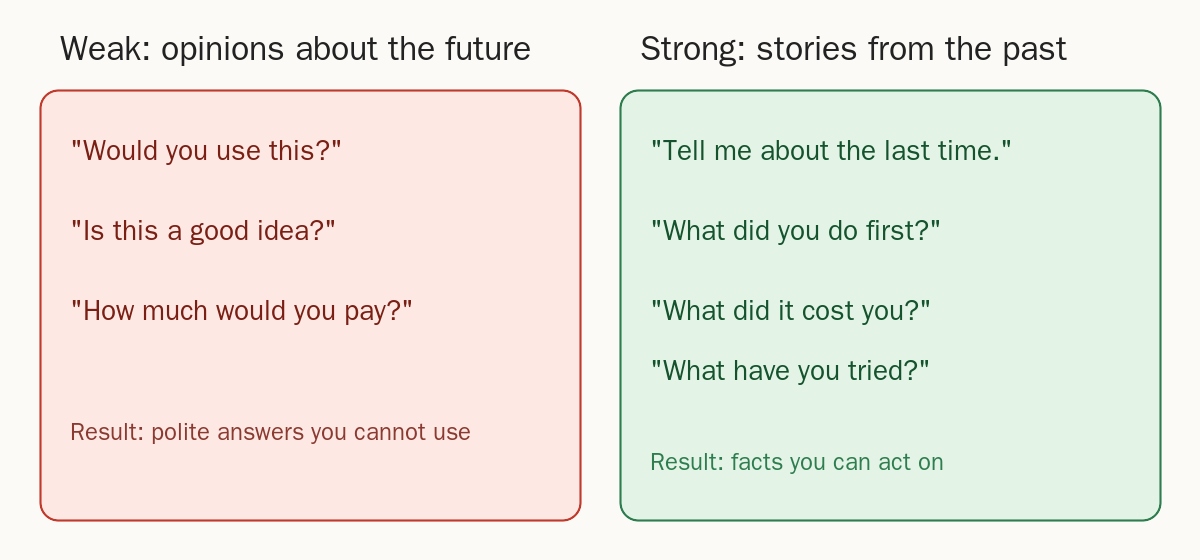
When you describe your idea and ask "Would you use this?", you get a polite yes. People want to be kind, and saying yes costs them nothing. They are guessing about their own future behavior, and people are poor at that.
Three questions to avoid:
- "Would you use a tool that does X?" It asks for a guess.
- "Do you think this is a good idea?" It asks for praise.
- "How much would you pay?" It asks for a number nobody has thought about.
All three invite a pleasant answer you cannot use. The fix is to stop talking about your idea and start asking about their life.
Find the right people to interview
Talk to people who have the problem now, not to friends who like you. Write one sentence naming the person and the task, such as: "Owners of small pottery studios who schedule classes by hand." Then look for ten of them.
Places to look: communities where they already talk, local businesses you can visit, people you know who know them, and customers of tools they use today. Keep the message short and ask for 15 minutes. Say you are researching a problem, not selling anything.
The post on how to get your first 10 customers has more on reaching people by hand. The same habits that find customers will find interviewees.
How to run the interview: ask about the past
The best rule is simple: ask about what happened, not what might happen. A story from last week is a fact. An opinion about next year is a guess.
Use this order, and make notes as they talk:
- Last time. "Tell me about the last time you scheduled a class." This gets a real story.
- What they did. "What did you do first? Which tools did you use?"
- What it cost. "How long did it take? What happened when it went wrong?"
- What they tried. "Have you looked for a better way? What did you try, and why did you stop?"
- Who else. "Who else deals with this? Could you introduce me?"
Do not pitch. If they ask what you are building, give one sentence and return to their story. Aim to talk for a fifth of the time.
A worked example: the pottery studio scheduler
Here is an invented example to show the method. Say your idea is an AI assistant that answers class booking messages for pottery studios. You interview eight studio owners.
Three of them tell you they spend about an hour each morning replying to booking messages. Two of those have already tried a booking widget and dropped it because customers kept messaging them anyway. One has paid a part-time helper to do it. The other five say booking is fine, and mention that their real problem is finding new students.
Read that honestly. Three of eight have the problem, and two have already spent effort on a fix. That is a real signal, but only for a narrow group. The five who did not care are information too: for them, your idea solves nothing. Your next step is to find more studios like the three, not to build for all eight.
The numbers here are made up to show the shape of the answers, so replace them with what real people tell you.
Signals that matter and those that do not
After each interview, sort what you heard.
- Strong signals: a specific recent story, a workaround they built, money or time they already spend, and a request to hear when you have something.
- Weak signals: compliments, "that sounds cool", vague interest, and feature requests with no story behind them.
- Warning signs: they cannot remember the last time it happened, or they have never tried to fix it. A problem nobody acts on is rarely worth building for.
A useful habit is to write down the exact words they used. Those words are your best landing page headline. Your own description of the problem is often the one customers never use.
The app's course Business Basics for Builders starts from the same question in its first lesson, Problems Worth Paying For: who has the problem, and is it painful enough to pay for?
Turn interviews into a decision
After eight to ten interviews, look for patterns. If the same problem appears in several stories, and a few people have already tried to fix it, you have something to test. If you hear ten different problems, your target group is too wide. Narrow it and interview again.
Interviews tell you the pain is real. They do not tell you whether people will act on your solution. For that, run a small test next. Offer a simple page that describes the result and ask people to join a waitlist. How to test demand with a landing page and a waitlist shows how, and the course Your First Builds: Simple Projects begins with Project 1: A Landing Page and a Waitlist.
If you are building on AI, also ask whether your idea is more than a thin layer over someone else's model. Is my AI startup just a thin wrapper around ChatGPT? gives a simple test. For the wider search for ideas, see how to find AI startup ideas that solve a real problem.
Common mistakes in customer interviews
- Interviewing friends. They want you to succeed, so they soften the truth.
- Leading the witness. If your question contains your answer, you will hear it back.
- Counting compliments as demand. Praise costs nothing. Time, effort and money do.
- Stopping after one interview. One story is an anecdote. A pattern needs several.
- Selling during the call. The moment you pitch, you stop learning.
Frequently asked questions
How many customer interviews do I need?
There is no magic number. Many founders start with about eight to ten and stop when new interviews keep repeating the same stories. If every interview sounds different, narrow your target group and start again.
Should I tell people about my idea?
Not at first. Ask about their past experience with the problem. Share the idea briefly at the end, and listen to how they react to a concrete next step, not to the concept.
What if nobody has the problem?
That is a useful result. You spent a few conversations instead of months of building. Go back to your list of problems and try the next one.
Can AI Entrepreneur do my customer interviews for me?
No. It teaches the method in short lessons, but you have to talk to real people yourself, and it cannot promise that any idea will work.
Get started
The Intermediate course Finding AI Opportunities has a lesson on talking to customers without fooling yourself, and another on telling a thin wrapper from a real product. After that, Launch, Price and Get Paid covers launching and finding the first ten customers.
Every lesson is free. Start learning with AI Entrepreneur: sign in on the home page and take your first short lesson today.