Platform Risk: Building a Business on Someone Else's Model
Platform risk is what happens to your business when the model it runs on changes, costs more or disappears. Learn how to spot it and limit the damage.
If your product calls someone else's AI model, that company controls a part of your business you cannot see into. It can change the model, raise the price, cap your usage or shut off an old version. That exposure has a name: platform risk. This guide explains what it is, how to measure how exposed you are, and what to do about it. The topic is the third lesson of the Intermediate course "Distribution and Moats" on AI Entrepreneur, a free web app of short lessons on building a business with AI.
What platform risk means for an AI product
Every business depends on something it does not own. A shop depends on a landlord. A seller depends on a marketplace. An AI product depends on a model provider.
Platform risk is the chance that a decision made by that provider hurts you, while you have no say in it. The decision is not personal and is not aimed at you. The provider is running its own business, and your product is one of thousands of customers.
The risk is not a reason to avoid building. Most useful products stand on someone else's work. The point is to know how much weight you have put on one support, and to keep a way out.
The four ways a model provider can hurt you
Think of four separate things that can go wrong. Each needs its own fix.
- Price. The cost per request goes up, or a cheaper plan you relied on ends. Your margin shrinks overnight.
- Behavior. The model is updated and answers differently. A prompt that worked last month now returns longer text, a different format or more refusals.
- Access. Your usage is capped, an old model version is retired, or the service is down when your customers need it.
- Competition. The provider adds your feature to its own product. What you sold as a business is now a checkbox in someone else's app.
The first three hurt a product that works. The fourth is harder, because it questions whether you had a business apart from the model. The lesson "Thin Wrapper or Real Product?" in the course "Finding AI Opportunities" is about that last question, and this post on thin wrappers goes through it in plain words.
How exposed are you? A five question check
Answer each question with yes or no. Each yes is a point of exposure.
- Does one provider handle every model call in your product?
- Would a price rise of 50 percent cut your margin below what you can live on?
- Does your prompt only work well with one specific model?
- Do you have no test that tells you whether a different model gives acceptable results?
- Could a customer rebuild your core feature in an afternoon with the same model?
Zero or one yes means you are in decent shape. Three or more means a single email from your provider could change your month. The five questions are the author's own checklist, not a standard. Use them as a prompt to think, not as a score to defend.
A worked example: a photo-listing tool
The numbers below are invented to show the method. They are not from a real business.
Say you run a small tool that writes product listings from photos for online sellers. Each customer pays you 20 dollars and makes about 200 listings in that time. Each listing costs you about 4 cents in model calls, so the model cost is 8 dollars per customer. Your gross profit per customer is 12 dollars. (If token billing is new to you, this guide to what an API call costs explains where a figure like 4 cents comes from.)
Now run the four risks against it.
- Price: if the provider raises its price by 50 percent, model cost goes to 12 dollars and your gross profit falls to 8 dollars. You survive, but a third of your margin is gone. If the rise were 150 percent, the cost would reach 20 dollars and you would lose money on every customer.
- Behavior: an update makes listings 30 percent longer, so your cost rises with it, and sellers start complaining about wordy copy.
- Access: the provider retires the model version you tuned your prompt on, with a few weeks of notice.
- Competition: an online marketplace adds a free "write my listing" button.
Each one has a different answer, and they are in the next section.
How to reduce platform risk without rebuilding
You do not need a big project. You need a few habits that cost little now and save a lot later.
Keep the model behind one door
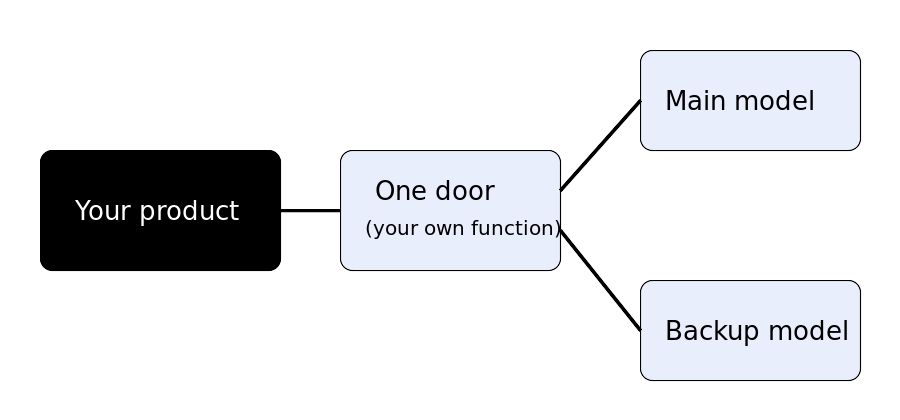
Put every model call in one place in your code, with a plain function such as "write a listing" that takes your input and returns your output. The rest of the product never mentions the provider by name. Switching models then means changing one file, not hunting through the whole product.
Test a second model before you need it
Run your real tasks through at least one other model every so often. You do not have to switch. You only need to know the answer to "what would happen if I had to?" The lesson "Choosing Models: Big, Small, Open, Closed" in the course "The AI Product Stack" is about this choice, and pricing so you do not lose money per user covers the margin side.
Measure quality with your own test set
When you can score outputs yourself, a model update is no longer a surprise. You run your test set, compare the number with the last one, and see whether anything broke. Without a test set you find out from angry customers. The Advanced course "Evals: Shipping AI That Works" is built around that habit.
Leave room in your price
In the example, a price rise of 150 percent breaks the business, and 50 percent only hurts. As a rule of thumb, aim for a margin where a 50 percent rise in model cost still leaves you profitable. If that is not true today, fix pricing before you fix anything else.
When switching models is easy and when it is not
Switching sounds simple: change the name, send the same prompt. Often it is not.
It is easy when your task is plain, like sorting messages into categories or turning a form into a sentence, and when you have a test set that tells you if the new answers are good enough. It is hard when your prompt has been tuned for the quirks of one model, when you use features only that provider offers, or when your product's quality depends on a model's particular style.
The more of your value that sits in your own data, workflow and customer relationships, the less it matters which model answers the call. That is the core of a moat, and what moats still work when anyone can call the same model explains which ones hold up. The goal is not to be independent of every provider. It is to be able to leave if you must, and to be worth keeping to your customers if the model gets better or cheaper for everyone.
Frequently asked questions
What is platform risk in simple terms?
It is the chance that a company you depend on changes its price, its product or its rules in a way that hurts your business. For an AI product, that company is usually the model provider.
Should I avoid building on someone else's model?
No. For most small teams, using an existing model is the only practical choice. Build on it, but keep the model behind one door and know what a second model would do.
Is open source the answer to platform risk?
It removes some risks, such as a provider retiring a model, but adds others, such as running and paying for the hardware yourself. It is one option to test, not a cure.
How often should I test a backup model?
A good habit is every time you change your prompt in a big way, and at least a few times a year. The test only has to tell you whether the backup is close enough to work.
Get started
Pick your product and answer the five questions above. Then write down what a 50 percent price rise would do to your margin. If you want a guided path, the course "Distribution and Moats" on AI Entrepreneur has three short lessons on getting in front of customers, which moats survive when AI is cheap, and building on someone else's model. Every lesson is free. Sign in on the home page with a 6-digit code sent to your email and take your first lesson.