AI vs Machine Learning vs Deep Learning: The Difference Explained
AI vs machine learning vs deep learning, in plain words: how the three nest inside each other, where ChatGPT fits, and which one your product needs.
If you have searched AI vs machine learning vs deep learning, you have probably seen the three words used as if they meant the same thing. They do not, and they are not rivals either. Each one sits inside the one before it. This guide explains each layer in plain words, builds one small support tool three ways so you can see the difference, shows where ChatGPT fits, and helps you pick the layer your product needs. If you want to go deeper, AI Entrepreneur is a free web app of short lessons on how modern AI works and how to build a business with it.
The short answer: three nested circles
Picture circles, one inside the other.
- Artificial intelligence (AI) is the biggest circle. It covers any machine that does a task we would call intelligent, however it was built.
- Machine learning sits inside AI. It is AI that gets better from data or experience instead of only following rules a person wrote.
- Deep learning sits inside machine learning. It is machine learning done with large neural networks that have many layers.
So all deep learning is machine learning, and all machine learning is AI. The reverse is not true. Plenty of AI uses no learning at all, and plenty of machine learning uses no neural networks.
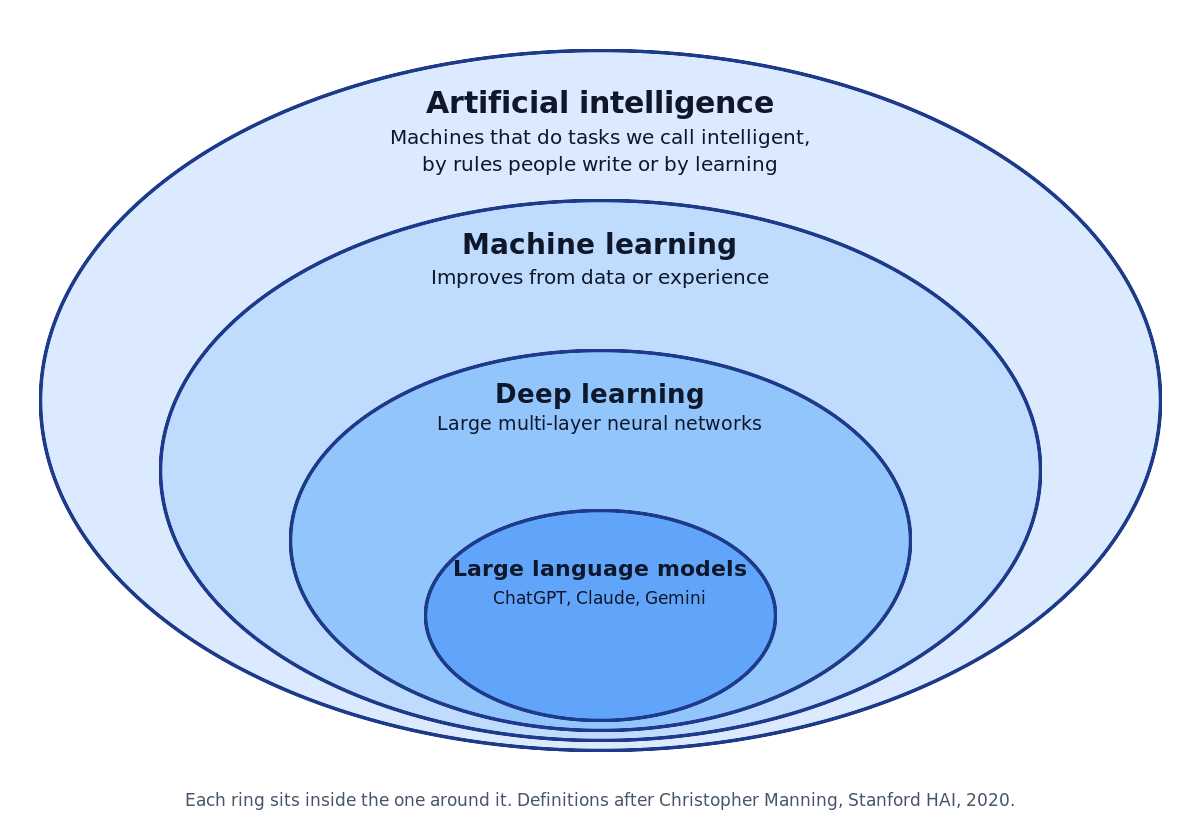
These definitions follow a one-page glossary by Stanford professor Christopher Manning, published by Stanford HAI in September 2020.
What artificial intelligence means
The term was coined by John McCarthy in 1955, who described it as the science and engineering of making intelligent machines. That is a goal, not a method. Planning a route, playing chess, sorting email and answering questions all count. The word says nothing about how you get there.
For decades, much of AI was people writing clever behavior by hand as "if this, then that" logic. Manning's glossary notes the shift since then: today the emphasis is on machines that learn.
Here is the worked example we will reuse. It is made up, but it is the kind of tool many small companies build first. You run a small software company and want to send each support ticket to the right team. A rules-based version looks like this:
- If the ticket contains
refundorinvoice, send it to billing. - If it contains
passwordorlogin, send it to accounts. - Otherwise, send it to general support.
That is AI in the broad sense: it makes a decision a person used to make. It also fails the moment a customer writes "I was charged twice" without the word refund. Rules work when the cases are few. Nobody can write a rule for every messy case.
What machine learning adds: learning from data
Manning defines machine learning as the part of AI that studies how computer programs improve from experience or data. Instead of writing the rules, you give the system examples and let it find the patterns.
Back to the ticket router. Say you export 5,000 past tickets that your team already sorted by hand. Each one has its text and a label: billing, accounts or general. You train a model on them, and it learns which words and combinations tend to go with which label. Now "I was charged twice" lands in billing, because tickets like it did before, even though nobody wrote a rule for it.
The loop is always the same:
- Collect examples with the right answer attached.
- Train a model to predict the answer from the input.
- Test it on examples it has never seen.
- Use it on new data, and keep checking that it still works.
Learning from labeled examples like this is called supervised learning. Manning's glossary names two other kinds. Unsupervised learning needs no labels and can set its own task, such as predicting each next word in a sentence. Reinforcement learning lets a system learn a sequence of actions by chasing a reward, such as winning a game. Keep the next-word idea in mind.
What deep learning changed
Deep learning is machine learning built on large neural networks with many layers. "Deep" just means many layers stacked up. Each layer turns its input into a slightly more useful version of it.
The big change is that a deep network can learn its own features from raw data. You do not tell it which words in a ticket matter. You give it enough examples and computing power, and it works out what to pay attention to. Writing in 2020, Manning called deep learning the most successful machine learning approach, usable for every kind of learning above.
It has costs. Training a large network from scratch takes a lot of data, chips and money, and it is hard to say why a deep model made any one decision. Manning also points to a wider shift: in these systems, much of the behavior comes from learning on data rather than from steps a person wrote, a change Andrej Karpathy called "Software 2.0".
How we got here is the Basic course The Road to the Age of AI in AI Entrepreneur, with lessons such as Data, Chips and the Deep Learning Breakthrough. For the short version, read our short history of AI from Turing to ChatGPT.
AI vs machine learning vs deep learning, side by side
Here is the same comparison, point by point, using the ticket router.
- Where the behavior comes from. Rules-based AI: a person writes the logic. Machine learning: patterns learned from labeled examples, often from features a person picked. Deep learning: patterns and features learned from raw data by a many-layered network.
- What you need to start. Rules-based AI: clear rules. Machine learning: a good set of labeled examples, often in a table. Deep learning: lots of data and computing power to train, or an existing model you can call.
- How easy it is to explain. Rules-based AI: very easy, you can read the rules. Machine learning: often easy for the simpler methods. Deep learning: hard, because the reasoning is spread across many layers.
- The ticket router. Rules-based AI: keyword rules. Machine learning: a model trained on your 5,000 sorted tickets. Deep learning: a network, or a large language model, that reads what the ticket means.
Where ChatGPT and large language models fit
Large language models, the technology behind ChatGPT, Claude and Gemini, live in the smallest circle. They are deep learning models trained on huge amounts of text. At their core they do one thing: predict the next piece of text. That is the self-set task from the unsupervised learning above, done at enormous scale. A raw model then gets more training to become a helpful assistant.
The Basic course How Modern AI Actually Works walks through exactly this in three lessons: Next-Token Prediction, From Raw Model to Helpful Assistant and What AI Gets Wrong. Our post on how large language models work covers the first idea in more depth.
For your ticket router, a language model means you may not need to train anything. You can send each ticket with an instruction like this:
You sort customer support tickets. Reply with one word: billing, accounts or general. Ticket: "I was charged twice this month and need it fixed."
That is deep learning doing the work, reached through a prompt instead of a training run. You still have to check the answers. A small test set of real tickets, graded the same way every time, tells you whether the prompt is good enough; our guide to building an eval set for an AI feature shows how.
Which one does your product need?
Start with the problem, not the word on the box. Then pick the simplest layer that solves it.
- The rules are clear and few. Write rules. They are cheap, fast and easy to fix. You do not need a model.
- You have clean, structured data and one clear thing to predict. Simpler machine learning may be enough, such as guessing which users will cancel from their usage numbers.
- Your input is messy text, images or audio. Deep learning is usually the right tool. For most early founders, that means calling an existing model through an API, not training one.
If you take the model route, the next questions are which model and what each request costs. The Intermediate course The AI Product Stack covers both, and our guide on choosing between open and closed AI models is a good next read.
One honest warning. A product that only passes a prompt to someone else's model can be easy to copy. The lesson Thin Wrapper or Real Product? in the course Finding AI Opportunities is about that risk.
Frequently asked questions
Is ChatGPT AI, machine learning or deep learning?
All three. ChatGPT runs on a large language model, which is a deep learning model, which makes it machine learning, which makes it AI.
Can you have machine learning without deep learning?
Yes. Methods like decision trees and regression learn from data without deep neural networks, and they often work well on data in tables.
Is deep learning always better than simpler machine learning?
No. Manning calls it the most successful approach overall, but for a small table of numbers a simpler method can be cheaper to run and far easier to explain.
Do I need to code to build something with AI?
Not to start. The Intermediate course Your First Builds: Simple Projects in AI Entrepreneur goes from no code to a little code, with a landing page, a prompt-powered micro tool and an automated workflow.
Get started
AI Entrepreneur has 12 courses and 36 lessons of 8 to 12 minutes each, with questions that check you and review that brings them back so they stick. The Basic courses need no background.
Every lesson is free. Start learning with AI Entrepreneur: sign in on the home page and take your first short lesson today.