What Is Startup Runway and How Do You Calculate It?
Learn what startup runway means, how to calculate it from cash and net burn, with a worked example, and how to extend it before the money runs out.
Runway is the number that tells you how long your startup can keep going before the money runs out. If you have been asking what is startup runway and how to calculate it, the short answer is this: divide the cash you have by the cash you lose each month. The details matter more than the formula, though, and the mistakes usually hide in the details. This post walks through both, with a worked example for a small AI startup. If you want short lessons on the numbers behind a business, AI Entrepreneur teaches them free, in lessons of 8 to 12 minutes.
What is startup runway?
Runway is the number of months your company can operate at its current spending before the bank balance hits zero. It counts only cash you can actually spend today. A signed term sheet that hasn't been wired, an invoice a customer hasn't paid, or a grant you hope to win does not count yet.
Think of runway as a clock, not a score. A long runway doesn't mean the business is working. It means you have time to find out. A short runway means every decision has a deadline attached to it.
Burn rate explained: gross burn vs net burn
Before you can calculate runway, you need your burn rate. There are two versions, and mixing them up is the most common mistake.
- Gross burn is everything you spend in a month: salaries, rent, software, model API bills, contractors, ads. It ignores revenue.
- Net burn is gross burn minus the cash that comes in from customers in that month. It is the amount your bank balance actually drops.
In formula form: net burn = monthly cash out - monthly cash in.
Gross burn tells you how expensive the company is to run. Net burn tells you how fast you are running out of time. Net burn sets the runway. Gross burn shows what happens if revenue stalls or a big customer leaves. If the difference between cash in and profit feels fuzzy, our post on the difference between revenue and profit for a startup covers it.
How to calculate startup runway step by step
- Find your cash on hand. Use the real balance in your business accounts today. Leave out money you are owed but haven't received.
- Add up last month's spending. Pull it from your bank statement, not your memory. Better still, average the last three months so one odd month doesn't skew the result.
- Add up last month's cash received. Use what actually arrived, not what you billed.
- Compute net burn. Spending minus cash received.
- Divide.
runway in months = cash on hand / net burn. - Adjust for known changes. A hire starting soon, an annual software bill, a price change. The simple formula assumes nothing changes, and something always does.
If net burn is zero or negative, you are taking in more than you spend, and runway stops being the main question.
A worked example: calculating runway for an early AI startup
Here is a made-up example to follow with your own numbers. Say you and a cofounder run a small AI writing tool for real estate agents. You have $120,000 in the bank. A typical month looks like this:
- Founder pay: $8,000
- Model API costs: $1,500
- Hosting and software: $700
- Everything else: $800
Gross burn is $11,000. Customers paid you $3,000 this month, so net burn is $8,000.
Simple runway: $120,000 / $8,000 = 15 months.
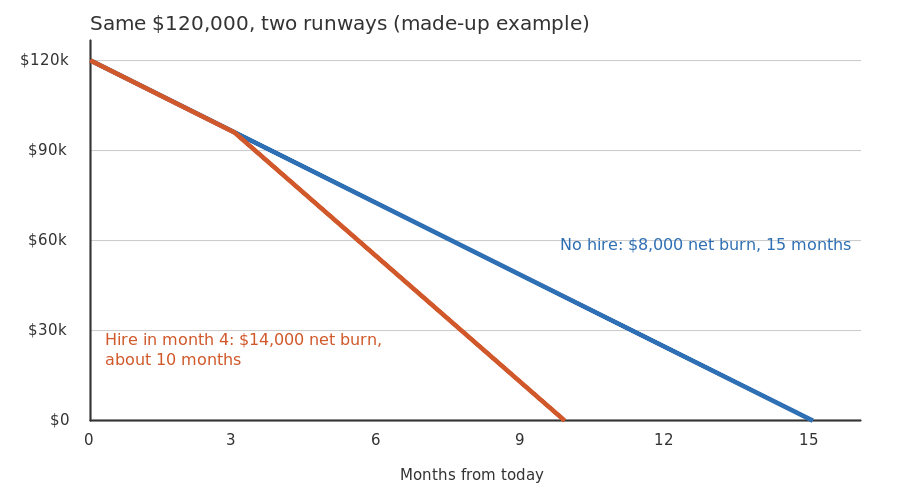
Fifteen months feels comfortable. Now add the plan you actually have. In three months you want to hire a part-time engineer at $6,000 a month. Revenue is growing, but each new customer also adds to your API bill, so suppose net burn after the hire settles at about $14,000.
- Months 1 to 3 at $8,000 net burn: $24,000 spent, leaving $96,000.
- From month 4 at $14,000 net burn:
$96,000 / $14,000 = about 6.9 months.
Real runway is about 10 months, not 15. Same bank balance, same company, five months gone because of one decision you already made.
There is a second lesson in this example that is specific to AI products. Your API cost goes up with usage. If a customer pays $50 but uses $25 of model calls, that customer adds $25 to your cash, not $50. Growth still helps, but less than the revenue line suggests. Model your API spend per customer, not as a fixed bill. The AI Entrepreneur lesson Model APIs, Tokens and What a Request Costs is about what each request costs, and Pricing AI Products is about pricing so you don't lose money on every user.
How much runway should a startup have?
There is no single right number. A better question is: how many months do you need to reach the next point where the company looks clearly better than it does today?
Work backward:
- Name the milestone. For example, a monthly revenue target, or a set number of paying customers who stay.
- Estimate honestly how long it takes at your current pace. If you track weekly growth, our post on what weekly growth rate an early startup should aim for helps you turn a growth rate into a date.
- Add the time a fundraise might take if you plan to raise after that milestone.
- Add a buffer for things going slower than planned, because they will.
If the total is longer than your runway, you have three options: spend less, earn more, or pick a closer milestone.
Paul Graham puts a sharper question on top of runway in his essay Default Alive or Default Dead? (October 2015). If your expenses stay the same and revenue keeps growing at the rate it has, do you reach profitability on the money you have left? He writes that half the founders he talks to don't know. He also warns against counting on investors to save you: treat raising money as plan A at most, and write down a plan B and the date you switch to it. Runway gives you the months; his question tells you whether those months end in profit or in a hard choice.
Common runway calculation mistakes founders make
- Counting revenue that hasn't arrived. Annual contracts billed but not paid, or money a payment processor still holds, are not cash.
- Ignoring lumpy costs. Annual software renewals, taxes, legal fees and equipment don't show up every month but still drain the account.
- Treating API costs as fixed. For AI products, model spend follows usage. A busy week can push the bill far above an average month.
- Counting on growth that hasn't happened. If your runway only works when revenue doubles, you have a hope, not a runway. Calculate the flat case too.
- Forgetting what it costs to get customers. Ads and sales effort raise burn before they raise revenue. Our guide to calculating customer acquisition cost shows how to put a number on it.
- Ignoring churn. Customers who leave take their revenue with them, and a churn rate that looks small adds up over a year.
How to extend your startup runway without killing growth
Cutting costs at random can slow down the very work that would save you. Cut in this order instead.
- Cut what doesn't touch customers. Unused software seats, nice offices, tools you signed up for and forgot.
- Lower your cost per request. For AI products, this is often the biggest lever. Shorter prompts, caching repeated answers, and a smaller model for simple tasks can cut spend without users noticing. The lesson Choosing Models: Big, Small, Open, Closed is about this trade-off.
- Raise prices or change the plan structure. If heavy users cost you more than they pay, a usage cap or a higher tier helps runway and margin at once.
- Collect cash earlier. Offer a discount for paying a year up front. The cash arrives now, which extends runway today.
- Delay hires until a clear bottleneck appears. In the example above, waiting three more months on the hire buys several months of runway.
Then recalculate. Each change should show up as a lower net burn number, not just a feeling of being more careful.
Frequently asked questions
Is runway calculated with gross burn or net burn?
Use net burn for your main runway number, because it reflects how fast your cash actually falls. Also calculate runway on gross burn as a worst case, which shows how long you would last if revenue dropped to zero.
How often should I recalculate my runway?
Once a month at minimum, using real bank figures. Recalculate right away after any big change, such as a hire, a lost customer, a price change, or a jump in API usage.
What is default alive vs default dead?
These are Paul Graham's terms. A startup is default alive if, with its current spending and growth, revenue will cover costs before the cash runs out, and default dead if the money runs out first unless something changes.
When should I start fundraising based on my runway?
Count backward from your runway. Take the time you expect a raise to take, add a buffer in case it goes slowly, and start before your remaining runway drops below that total.
Get started
Runway is simple division on top of numbers that are easy to get wrong: revenue, costs, unit economics and growth. AI Entrepreneur's Basic course Business Basics for Builders has three short lessons on them, including Revenue, Costs and Unit Economics and Growth: The Number a Startup Lives By. The Advanced lesson The Economics of AI Companies goes further into how AI costs shape a business. Lessons put a problem first and use varied questions with hints, and every lesson lists its sources. Questions from finished lessons come back in a daily review, up to 5 a day.
The app teaches. It won't run your finances for you, and it gives no personal legal, tax or investment advice.
Every lesson is free. Start learning with AI Entrepreneur: sign in on the home page and take your first short lesson today.