How to Calculate Customer Acquisition Cost for a Startup
Learn how to calculate customer acquisition cost for a startup step by step, what to include, how to read CAC against LTV, and how to lower it over time.
Customer acquisition cost, or CAC, is the money you spend to win one new paying customer. If you want to know how to calculate customer acquisition cost for a startup, the maths is simple. The hard part is deciding what counts as a cost and what counts as a customer. This guide gives you the formula, a worked example with numbers you can swap for your own, and the mistakes that make early CAC figures look better than they are.
CAC is one of the few numbers that tells you whether a startup can grow without running out of cash. The numbers around it, such as revenue, costs, unit economics and growth, are what the course Business Basics for Builders in AI Entrepreneur walks through.
What customer acquisition cost (CAC) means for a startup
CAC answers one question: how much did it cost to get one customer to pay you for the first time?
It matters because every customer you add has two sides. On one side is what you spent to get them. On the other is what they pay you over time. If the first is bigger than the second, growing faster only makes you lose money faster.
Two words in the definition do a lot of work. New means you count only customers you did not have before. Paying means a signup, a free trial or a waitlist entry is not a customer yet.
How to calculate customer acquisition cost for a startup: the basic formula
Pick a period, such as a month or a quarter. Then:
CAC = total sales and marketing cost in the period / number of new paying customers in the period
If you spent $3,000 on sales and marketing in a month and won 40 new paying customers, your CAC is $75.
Use the same period for both numbers. Use the same definition of "customer" every time, or you will not be able to compare one month with the next.
What to include in your CAC calculation
The cost side is where most startups cheat without meaning to. Count everything you spent to bring in customers:
- Paid media: ads on any platform.
- People: salaries or contractor fees for anyone doing marketing, outreach or sales. Include your own time if you do this work, and give it a fair hourly value.
- Tools: email software, outreach tools, analytics and landing page tools you use for acquisition.
- Content and creative: freelancers, designers, video, written pieces.
- Extras: sales commissions, event costs, free samples or discounts you gave to win the first sale.
Leave out the cost of serving customers once you have them, such as model API fees, hosting and support. That belongs in your costs of delivery, and it matters for gross margin and payback below. If you run an AI product, how token billing works will help you work out that side.
Worked example: calculating CAC step by step
These numbers are made up to show the method. Imagine a small AI writing tool that sells a $25 monthly plan. Last month it spent:
- Paid ads: $1,200
- Content freelancer: $800
- Outreach contractor: $800
- Outreach and email tools: $200
Step 1: add up the cost. $1,200 + $800 + $800 + $200 = $3,000.
Step 2: count new paying customers. The company gained 40. The payment system shows 12 came from ads, 8 from outreach and 20 from people who found the content.
Step 3: divide. $3,000 / 40 = $75 blended CAC.
That number is a starting point. The next section shows why the average hides what is going on.
Blended CAC vs paid CAC vs channel CAC
There are three versions of the number, and each one answers a different question.
- Blended CAC divides all acquisition cost by all new customers, whatever the source. In the example it is $75. It tells you how the business as a whole is doing.
- Paid CAC divides only paid spend by customers that came from paid sources. Here, $1,200 / 12 = $100.
- Channel CAC does the same for one channel at a time. Outreach cost $800 + $200 = $1,000 for 8 customers, so $125. Content cost $800 for 20 customers, so $40.
Look at the spread. Content is cheapest, ads sit in the middle and outreach is the most expensive. The blended $75 would have told you none of that.
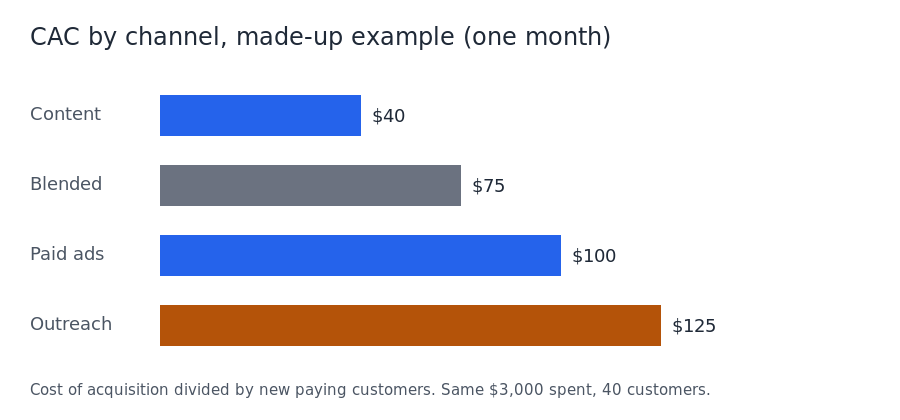
Blended CAC can also flatter you. Customers who arrive by word of mouth pull the average down, but you cannot buy more of them on demand. When you decide where to spend the next dollar, look at channel CAC. Picking channels is its own skill, and finding the right distribution channel goes through it. The course Distribution and Moats in AI Entrepreneur also covers how customers actually find you.
How to judge your CAC: LTV to CAC ratio and payback period
A CAC of $75 is neither good nor bad by itself. It depends on what a customer is worth. Two checks help.
LTV to CAC ratio
Customer lifetime value (LTV) is the gross profit a customer brings you over the time they stay. Divide it by CAC. Use gross profit, not revenue, because revenue ignores what it costs to serve them. The difference is explained in revenue vs profit for a startup.
Back to the example. The plan brings in $25 a month, and serving one customer costs $15 in model and hosting fees. That leaves a gross profit of $10 a month. If 5% of customers cancel each month, the average customer stays about 20 months (1 / 0.05). So LTV is about 20 x $10 = $200. The ratio is $200 / $75, about 2.7. Run the same check on the weakest channel: $200 / $125 is 1.6, which is thin. For how to get the churn and LTV inputs, read how to calculate both customer lifetime value and churn.
A ratio below 1 means you lose money on every customer. Where to set your own bar above that depends on your margins and how much cash you have, so decide it before you scale spend.
CAC payback period
Payback is how many months of gross profit it takes to earn back the CAC. Here: $75 / $10 = 7.5 months. For outreach: $125 / $10 = 12.5 months.
Payback matters most when cash is tight. A customer with a great lifetime value still hurts if you wait a year to get your money back and you cannot fund that gap. In this example, outreach is the channel that would strain you.
Common CAC mistakes early-stage startups make
- Counting only ad spend. Your own time, contractors and tools are real costs. Leaving them out is the most common way to get a CAC that looks great.
- Counting signups as customers. A free account is not a paying customer. Divide by people who paid.
- Ignoring the time lag. If a sale takes six weeks to close, spend from this month may win customers next month. Compare a longer period, or match spend to the customers it produced.
- Using revenue for payback. Revenue overstates how fast you earn the money back. Use gross profit.
- Trusting a tiny sample. With a handful of customers, one lucky referral can halve your CAC. Treat early numbers as rough and keep tracking.
- Only watching the blended number. As the example showed, one cheap channel can hide an expensive one.
How to lower your customer acquisition cost
You can cut CAC by spending less per prospect, converting more of them, or both.
- Talk to buyers first. Clear messaging comes from knowing the exact problem your customers have. Customer interviews give you the words to use in ads and outreach.
- Cut the weakest channel and move money to the strongest. In the example, shifting budget from outreach toward content lowers blended CAC, as long as content keeps working at higher volume. Test that before assuming it.
- Improve conversion. If more visitors become paying customers for the same spend, CAC falls. Check your landing page, your offer and the steps between signup and payment.
- Make referrals easy. Customers who bring friends cost you little. Ask happy customers directly.
- Win the first ten by hand. Early on, doing things that do not scale teaches you who buys and why. The Launching and the First Ten Customers lesson in the Launch, Price and Get Paid course is built around this.
- Review your price. A higher price does not lower CAC, but it shortens payback because each customer returns more gross profit per month.
Frequently asked questions
What is a good CAC for a startup?
There is no single good number. A CAC is good when it is comfortably below what the customer is worth in gross profit, and when you can earn it back in a time your cash can handle.
Should I include my own time in CAC?
Yes, if you spend it on marketing or sales. Give your hours a fair value, or your CAC will look lower than it really is.
How often should I calculate CAC?
Monthly works for most early startups. Calculate it by channel as well as blended, and look at longer periods if your sales take weeks to close.
What is the difference between CAC and cost per lead?
Cost per lead divides spend by people who showed interest, such as signups. CAC divides spend by people who actually paid, so it is always the stricter number.
Get started
CAC only makes sense next to revenue, costs and growth, and those are the topics the short lessons in Business Basics for Builders walk through with questions you answer as you go.
Every lesson is free. Start learning with AI Entrepreneur: sign in on the home page and take your first short lesson today.