AI Company Economics: How They Differ From SaaS
AI company economics differ from SaaS because every request has a real cost. See a worked example of margins, pricing and the numbers to track before you scale.
If you know software businesses, you already know a lot about money. But AI company economics are not the same as SaaS economics, and the difference matters before you set a price or promise a margin. The short version: in SaaS, serving one more customer costs almost nothing. In an AI product, every request has a real cost, and that changes pricing, margins and what you track. This post walks through the differences with a worked example. AI Entrepreneur, a free web app of short, hands-on lessons, has an Advanced course on scaling an AI company that is about the same questions.
AI company economics: the short answer
A classic SaaS product is built once and sold many times. After the software exists, an extra user adds a small amount of hosting and support cost. So revenue grows much faster than cost to serve.
An AI product adds a cost that scales with use. Each time a customer asks your product to do something, you may call a model, and the model provider charges for that call. More use means more cost, even if the customer pays you the same amount.
That one change drives everything else in this post:
- Your cost of serving customers is bigger and less predictable.
- Flat pricing can hide losses.
- Your heaviest users can be your least profitable ones.
- Your costs depend on a supplier you do not control.
Gross margins: why SaaS-style margins do not carry over
Gross margin is revenue minus the direct cost of serving customers, divided by revenue. For a SaaS product with cheap hosting, that cost is small, so the margin is high. You should not assume the same for an AI product. Model calls sit inside the cost of serving, and they can be a large share of it.
There is a published benchmark, and it is one view, not a law. In 2020, Martin Casado and Matt Bornstein of Andreessen Horowitz wrote that AI companies often have gross margins in the 50 to 60 percent range, below the 60 to 80 percent or more they cite for comparable SaaS businesses. They describe their figures as anecdotal and drawn from interviews with AI startup founders. They point to cloud costs for training and running models, and to human work on data, as reasons. Read their article, The New Business of AI (and How It's Different From Traditional Software), and treat the numbers as a prompt to check your own, not a target.
Here is a worked example. The numbers are invented to show the mechanics, not to describe any real product.
- You sell a writing assistant for a flat 30 dollars a month.
- Assume each request costs you 3 cents in model fees.
- A light user makes 50 requests a month. Cost: 1.50 dollars. Gross margin: 95%.
- A typical user makes 400 requests. Cost: 12 dollars. Gross margin: 60%.
- A heavy user makes 1,500 requests. Cost: 45 dollars. You lose 15 dollars on that customer every month.
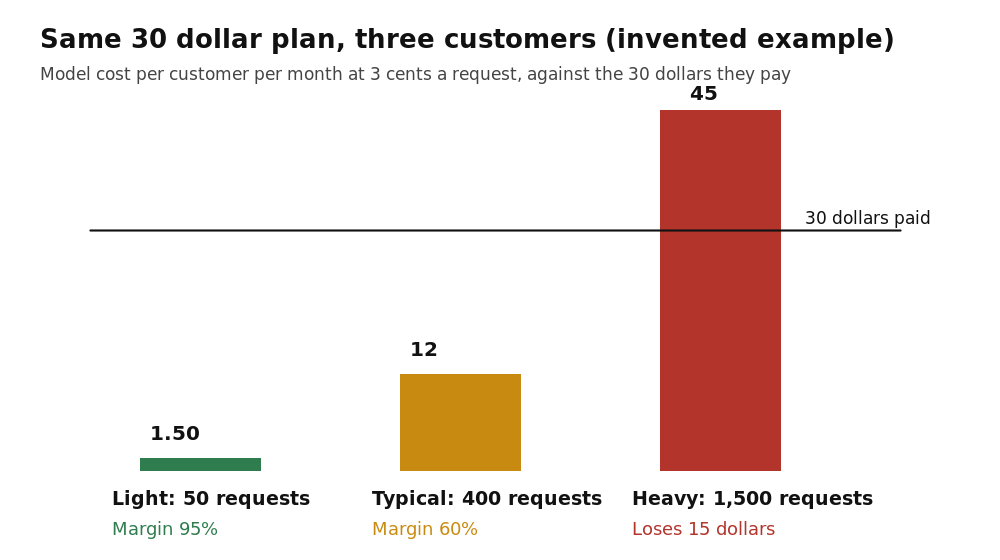
Same product, same price, three very different businesses. If you only look at the average, you might miss that the heavy users are what drag it down. Unit economics is the tool for exactly this kind of check.
Inference, compute and model costs as a core cost of revenue
Inference means running a model to produce an answer. When you use a model through an API, you pay per token, which is a chunk of text the model reads or writes. A request costs more when the input is longer, the output is longer, or you use a larger model.
So the cost of a request is something you can influence. These are the main levers:
- Prompt length. Sending a whole document when a paragraph would do raises cost on every call.
- Model choice. A bigger model may give better answers, but a smaller one can handle simple tasks for less. The AI Entrepreneur lesson "Choosing Models: Big, Small, Open, Closed" is about this trade-off.
- Number of steps. A feature that makes five model calls costs roughly five times one that makes a single call.
The habit to build: measure the cost of one request before you launch, not after the first invoice. Log tokens in and out, and multiply by the provider's current price.
Pricing models: seats, usage and outcomes
SaaS often charges per seat. That works because cost to serve barely changes with how much each seat is used. With AI, a seat price can break, as the example above shows. You have three broad options.
Seats
Simple to sell and easy to understand. The risk is the heavy user who costs more than the seat brings in. You can limit the risk with fair-use caps or tiers.
Usage
Customers pay for what they consume: requests, documents, minutes. Your revenue rises with your costs, which protects margin. The downside is that customers dislike surprise bills, so you need clear limits and estimates.
Outcomes
Customers pay when the job is done, such as a resolved support ticket or a finished report. This matches price to value. But you now carry the cost of failed attempts, and you need a reliable way to say what "done" means. That takes measurement. See how to build an eval set for a way to judge outputs without guessing.
Many products mix these: a base fee with a set amount of usage included, plus a charge beyond it. The "Pricing AI Products" lesson in the app is about this problem: pricing an AI product without losing money on every user.
Cost to serve and why heavy users can hurt you
In SaaS, a power user is often a happy customer who adds little to your costs. In AI, a power user can be a cost center. Three patterns cause most of the trouble:
- Long inputs. A user who pastes huge documents on every request multiplies your token bill.
- Retries and loops. If your product runs an agent that tries again when it fails, one task can trigger many model calls. Each extra call adds cost, and a failed attempt still has to be paid for.
- Free tiers. A free user costs real money every time they use the product. Decide what a free user is worth to you before you open the door.
Fixes are mostly boring. Set limits per plan. Route easy tasks to cheaper models. Cache answers you have already computed. Cut steps that do not improve the result. Then check cost per customer each month, not just the total.
Moats, platform risk and defensibility
SaaS companies often defend themselves with switching costs, integrations and data. Those still matter. But AI adds a new problem: if your product is a thin layer over a model that anyone can call, it is easier for a competitor to match the core. The Intermediate lesson "Thin Wrapper or Real Product?" is about facing that question early.
There is also a dependency. Your largest cost, and your core capability, may come from one provider. If that provider changes its price, its terms or its model, your economics change overnight. Platform risk is worth planning for, for example by keeping your prompts and evals portable so you can test another model.
The app's lesson "What Moats Survive When AI Is Cheap" is about which protections hold up.
What to track: the metrics that matter for an AI company
You still need the SaaS basics: growth, retention and payback on what you spend to win customers. Add these to see the AI-specific side:
- Cost per request or per task. The base unit of your costs.
- Gross margin by customer or plan, not just overall. Averages hide the heavy-user problem.
- Tokens per task. A rising number is an early warning that costs are creeping up.
- Quality score from your eval set. You cannot safely cut costs, such as switching to a cheaper model, unless you can see whether quality held.
- Usage distribution. What share of your cost comes from your top 10% of users?
Quality and cost are linked. A cheaper model that gets answers wrong can create support work and churn. If you want a bigger map of the journey from first project to company, see this roadmap from side project to AI company.
Frequently asked questions
Are AI company margins always lower than SaaS margins?
Not always, but you cannot assume they match. One a16z article from 2020 reported lower margins for AI companies on average, based on founder interviews. Your margin depends on how much each request costs, how often customers use the product and what you charge. Work it out for your own product with real numbers.
Should I charge per seat or per usage for an AI product?
It depends on how much usage varies between customers. If it varies a lot, usage-based pricing or a seat price with caps protects your margin better than a flat seat fee.
What is the first number I should calculate?
The cost of one request or one completed task. Multiply tokens in and out by your provider's current price, then multiply by how many requests a typical and a heavy user make.
Does this mean AI companies cannot scale like SaaS?
No. It means scale depends on managing cost per task, pricing well and building real defensibility. The economics are different, not worse by default.
Get started
The economics of an AI company make more sense when you work the numbers yourself. The Advanced course "Scaling an AI Company" includes a lesson called "The Economics of AI Companies", and the Intermediate course "Launch, Price and Get Paid" includes "Pricing AI Products". They are short, hands-on lessons.
Every lesson is free. Start learning with AI Entrepreneur: sign in on the home page with a 6-digit code sent to your email and take your first short lesson today.