How to Tell if a Problem Is Worth Building a Startup Around
Not every problem deserves a startup. Learn how to test whether a problem is painful, frequent, and valuable enough to build a business around before you commit.
Most ideas feel good for a weekend and then fade. The question is how to tell if a problem is worth building a startup around before you spend months on it. You can answer it in about a week, with a few conversations, some simple arithmetic and one small test. This post gives you that process. AI Entrepreneur, a free web app of short lessons on building a business in the age of AI, teaches the same idea. Its Basic course "Business Basics for Builders" opens with a lesson called "Problems Worth Paying For".
Why most startup problems are not worth solving
A problem can be real and still be a bad foundation for a company. Three things go wrong again and again.
- The problem is mild. People notice it, shrug and move on.
- The problem belongs to you, not to a market. It annoys you, but you cannot find ten other people who care.
- The problem is real, but nobody pays to fix it. People complain happily and never open their wallets.
AI makes building easier, so picking the right problem matters more. If you are still hunting for candidates, start with how to find AI startup ideas that solve a real problem, then come back here to test the best one.
How to tell if a problem is worth building a startup around: four signs
Here is how to tell if a problem is worth building a startup around. Look for four signs. You do not need all four to be perfect, but you need evidence for each one.
- It hurts often. The person runs into it weekly or daily, not once a year.
- It costs real time or money. You can put a number on it, even a rough one.
- They already try to fix it. They use a spreadsheet, a hired helper, a clumsy tool or a long manual routine.
- Someone has the budget and the authority to pay. A person exists who can say yes without a long chain of approvals.
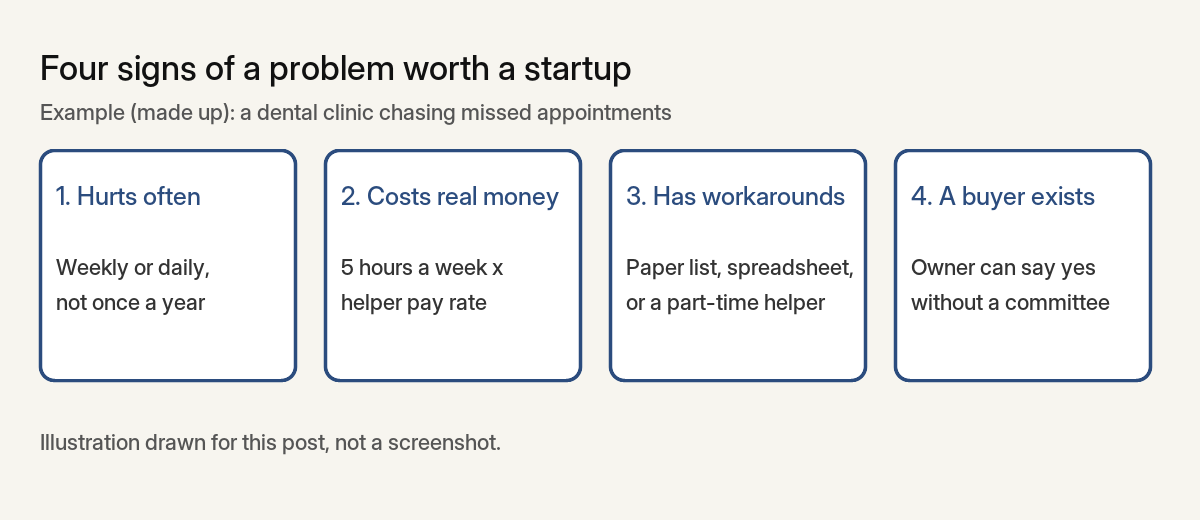
The rest of this post shows you how to check each sign with evidence instead of a feeling.
How painful is the problem really? Look for existing workarounds
The best proof of pain is effort someone already spends. Ask yourself what people do today when the problem hits. If the answer is "nothing", be careful. A problem nobody works around is often a problem nobody cares enough to solve.
Take a worked example with an imagined business. Say you suspect that small dental clinics lose time chasing patients who skip appointments. You talk to the people who run the front desk and ask:
- "Tell me about the last time a patient did not show up. What happened next?"
- "What do you do today to stop it?"
- "How long does that take each week?"
- "What have you tried that did not work?"
Now listen for workarounds. One clinic keeps a paper list and phones people by hand. Another pays a part-time helper. A third built a clumsy spreadsheet. Each workaround is a signal. It shows the problem is painful enough to spend effort on, and it shows you what you must beat.
Ask about the past, not the future. "Would you use a tool that does this?" invites a polite yes. "What did you do the last time this happened?" invites a true story. The Intermediate lesson "Talking to Customers Without Fooling Yourself" in AI Entrepreneur is built around this exact habit.
Check who pays and how much the problem costs them
Pain is not the same as willingness to pay. You need to find the buyer and put a price on the problem.
Start with the cost of the problem. In the dental example, suppose the helper spends five hours a week on reminder calls. Multiply those hours by what the clinic pays for them. That is a floor for what the problem costs. A tool priced well below that figure has a clear story. A tool priced above it has a hard sell.
Then find the buyer. The person who feels the pain is not always the person who pays. A front desk worker may hate the calls, but the owner approves the spend. Ask in every conversation: "Who decides to buy something like this?" If the answer is a committee or a slow procurement process, a small team will struggle to get its first customers.
Keep your own costs in view too. If an AI product costs you more to serve each customer than they pay, a big market will not save you. The lesson "Revenue, Costs and Unit Economics" covers this, and our post on the difference between revenue and profit explains why the gap matters.
Size the market without fake top-down numbers
Do not start with a line like "the global market is worth billions and we only need one percent". It sounds serious and tells you nothing. Build the number from the bottom up instead.
Use this formula: the number of customers you can actually reach, multiplied by what each one would pay in a year.
Here is an illustration with made-up numbers. Say you can name 200 clinics in your region, and you believe each would pay $50 a month. That is 200 x $50 x 12 = $120,000 a year. Now you have something to reason about. Ask:
- Is that enough to be worth my time?
- Can I reach those 200 clinics, and how?
- Does the same problem exist in other regions or other kinds of business, so I could grow later?
A small number is not a failure. It may be a good first market, and many companies begin in a narrow group. A number you cannot reach is the real warning. If you cannot say how you would get in front of those customers, read about how to find the right distribution channel before you go further.
Run a quick validation test in one week
You can test a problem in a week without writing real software. Here is a plan.
- Days 1 and 2: talk to five people. Use the past-tense questions above. Write down their exact words, the workarounds and the costs.
- Day 3: write one sentence. Use this shape: "For [specific person], who [has this problem], we [do this], so they [get this result]." If you cannot fill it in, the idea is still vague.
- Days 4 and 5: build a landing page with a waitlist. Describe the problem and the promised result in plain words. The first hands-on project in AI Entrepreneur, "Project 1: A Landing Page and a Waitlist", is built around exactly this kind of demand test.
- Days 6 and 7: send it to the people you spoke with and to a few more like them. Count who signs up, who replies and who asks when they can start.
Decide your bar before you begin. For example: "If at least three of the five people ask for a trial, I continue." Setting the bar in advance stops you from bending the result to fit what you hoped for. Replies like "sounds interesting" do not count. A request for access, a reply with a real question or an offer to pay does count.
If you have no audience yet, that is fine. You only need a handful of the right people, and our post on launching an AI product when you have no audience shows where to find them.
Red flags that mean you should walk away
Walking away early is a win. It saves you months. Watch for these signs:
- Nobody has a workaround. People say it is annoying, yet they do nothing about it.
- The only fan is you. Friends and family say it is a great idea, and strangers in the target group do not respond.
- You cannot name the buyer. Everyone likes it and nobody owns the budget.
- The cost of the problem is tiny. If it costs a customer a few dollars a year, no price will make a business.
- The solution is a thin layer on a general chatbot. If a customer could get the same result by typing a prompt into a public assistant, you have little to sell. Our post on whether your AI startup is just a thin wrapper around ChatGPT helps you check.
- You only hear compliments. Polite praise without a request for access, a reply or a price question is not evidence.
If you hit two or three of these, go back to your list of ideas and test the next one. Dropping a weak problem is the process working as it should.
Frequently asked questions
How many people should I talk to before deciding?
Five to ten people from the same narrow group is a good start. If their answers keep repeating the same pains and workarounds, you have a pattern. If every answer is different, narrow your target group.
Does a small market mean the problem is not worth solving?
No. A small, reachable market with a painful problem is often a better place to start than a huge one you cannot reach. Size it bottom up, and check whether the same problem shows up in nearby groups.
What if people say they would pay but never sign up?
Trust what people do over what they say. A waitlist signup, a reply or a payment is stronger evidence than a polite yes in a conversation.
Can I test a problem without building a product?
Yes. Customer conversations and a simple landing page with a waitlist are enough for a first test. You do not need working software to learn whether people care.
Get started
Pick one problem and run the week above. If you want a guided path through the thinking, the lessons on problems worth paying for, talking to customers and avoiding a thin wrapper are short, with questions that check what you learned.
Every lesson is free. Start learning with AI Entrepreneur: sign in on the home page and take your first short lesson today.