When Should a Startup Make Its First Hire? Four Checks
When should a startup make its first hire? Later than most founders think. Four checks, a runway example and the setups to try before a full-time hire.
When should a startup make its first hire? Later than most founders think, and only when one named job is holding back growth you can already see. This guide gives you four checks to run in order, a worked runway example, and the cheaper setups to try before you add a full-time person. The numbers behind the decision, costs, runway and growth, are what AI Entrepreneur teaches in free, short lessons.
When should a startup make its first hire? The short answer
Hire when three things are true at once:
- You have demand you can see: paying customers, or usage that keeps growing week after week.
- One kind of work is now the bottleneck, and you can name it in a sentence.
- You can pay for the hire and still have enough months of cash to learn whether it worked.
If any of the three is missing, a hire adds cost without adding speed. A new person needs direction. If you do not yet know what customers want, you cannot give it, and you both end up guessing.
Why waiting is usually the right call
Paul Graham makes the case for waiting in his essay How to Start a Startup (March 2005). He calls not hiring the most important way a startup saves money. People are a recurring cost, he points out, the worst kind, and every extra person turns a quick chat into a meeting. His test is short: "The only reason to hire someone is to do something you'd like to do but can't."
That test rules out two common reasons to hire. The first is filling boxes on an org chart because a "real company" has a head of marketing. The second is relief: you want help because the work is boring, not because it blocks growth. Boring work with fixed steps is often a job for software, not a salary.
The four checks, in order
Run these one at a time. Stop at the first one that sends you out to the side.
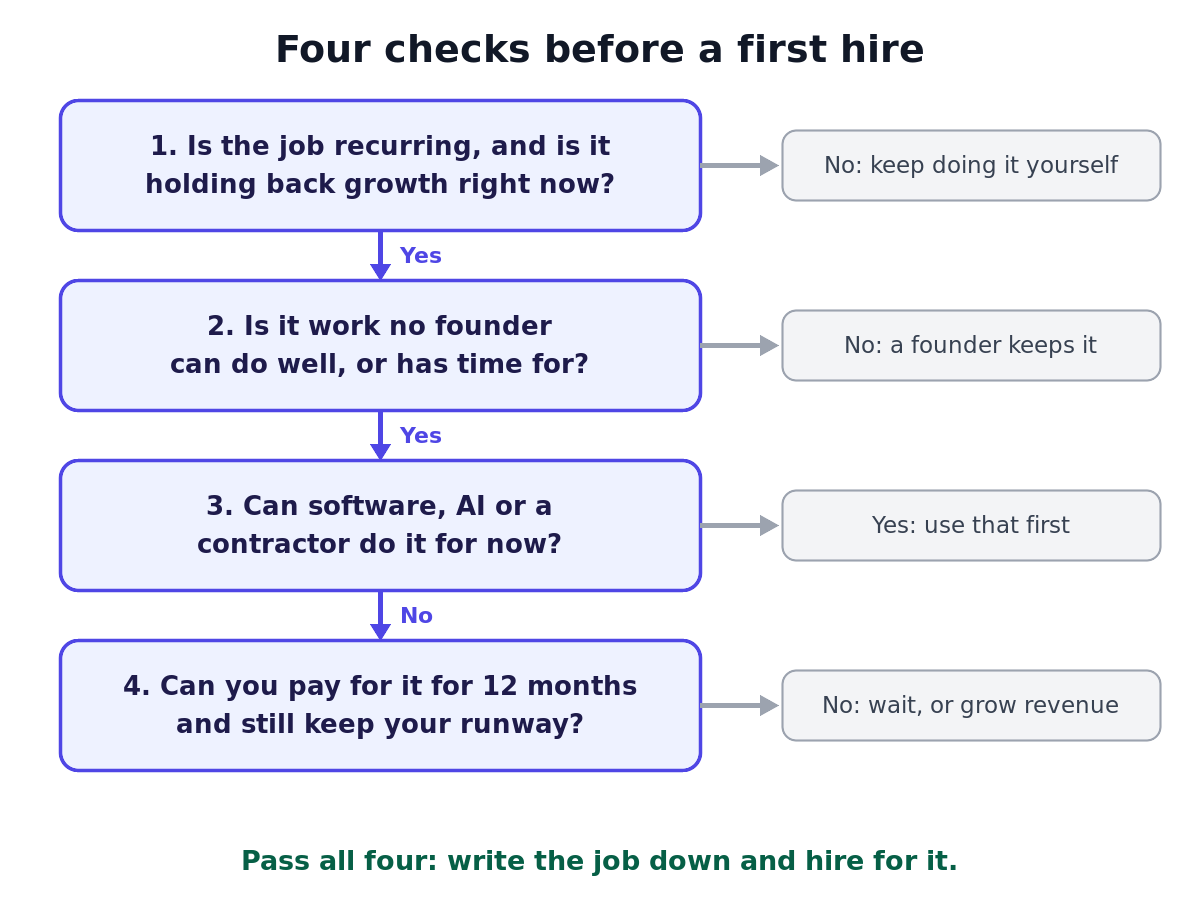
- Is the job recurring, and is it holding back growth right now? Support emails wait three days. Sales calls get pushed. Customers notice. A one-off project, like a site redesign, is not a reason to hire.
- Is it work no founder can do well, or has time for? If a founder can learn it in a few weeks, that is often faster than hiring. Some work stays with founders anyway: talking to customers about what to build next and setting direction.
- Can software, AI or a contractor do it for now? If yes, try that first. It costs less, and it shows you what the job really involves before you write a job description.
- Can you pay for it for 12 months and still keep your runway? A hire needs time to find, time to learn the work, and time to show results. If the cash runs short before that, wait or grow revenue first.
Before check 1, keep a time log for one week: every task, how long it took, and whether it moved revenue. That log answers the first three checks for you.
A worked example: the runway check
Runway is how many months you can keep going before the cash runs out. A hire changes it fast, so do the sum before you post a job. For the full method, see what startup runway is and how to calculate it.
Here is an example with made-up numbers. Follow it with your own.
- You have $120,000 in the bank.
- After revenue comes in, you still spend $8,000 more than you earn each month. Runway: 120,000 divided by 8,000 is 15 months.
- A full-time hire would cost about $7,000 for each month, all in: pay, taxes and tools. Your monthly gap grows to $15,000.
- New runway: 120,000 divided by 15,000 is 8 months.
You just traded 7 months of runway for one person, and the hire fails check 4: you cannot pay them for 12 months. Count the months to find someone and get them up to speed too. A hire who starts in month 2 and is fully useful in month 4 gives you far less than 8 months of results.
Now try the cheaper setup from check 3. A contractor for 10 hours a week costs, say, $2,000 for each month. Your monthly gap becomes $10,000, and 120,000 divided by 10,000 is 12 months. That passes check 4, and in those months you learn whether the work moves revenue. If it does, the full-time hire later starts with a clear job and better numbers.
To know whether a hire can pay for itself, you also need what each customer brings in and costs you to serve. Unit economics gives you that number.
How AI tools let you delay the first hire
The work a tool can take is bigger than it used to be. Before you hire, try to clear it.
Start by pasting your time log into an AI assistant with a prompt like this:
Here is every task I did this week and how long it took. Sort them into three groups: tasks that need my judgment, tasks a person could do with a written guide, and tasks that follow fixed steps and could be automated. For the automatable ones, list the steps in order.
Then pick one fixed-steps task and automate it. For example: every new signup is added to a spreadsheet, tagged by company size, and sent a welcome email. That is a workflow with clear steps. If you have not built one, follow how to automate a boring workflow with AI, step by step.
Two cautions. AI makes mistakes, so check its output before it reaches a customer. And a fixed workflow, which runs the same steps every time, is easier to trust than an agent that picks its own steps. Some founders take this far and run a business with very few people; how a tiny team can run a large AI business shows how.
Contractor, part-time, full-time or cofounder
The first hire does not have to be a full-time employee. Pick the setup that fits how sure you are about the role.
- Contractor or freelancer. Good when the work is clear and has an end, like a single feature. Low commitment on both sides, and a way to test whether a role is needed at all.
- Part-time employee. Good when the work is ongoing but not yet a full week, like customer support.
- Full-time employee. Good when the bottleneck is steady and central to growth, and the runway check passes.
- Cofounder. Not a hire. A cofounder shares ownership and long-term direction. Bring one in because you want a partner for years, not because you need help this month.
Rules on who counts as an employee or a contractor, and how equity works, differ by country and state. Talk to a lawyer or accountant where you live before you sign anything. AI Entrepreneur teaches business basics; it does not give personal legal or tax advice.
Frequently asked questions
How much revenue should a startup have before hiring?
There is no single number. What matters is whether your cash in the bank, with revenue coming in, can carry the hire for about a year. Run the runway check above with the hire's full monthly cost included.
Should a startup's first hire be technical or sales?
Hire for the gap your time log shows. If you build well but deals stall, hire for sales; if you sell well but the product cannot keep up, hire an engineer.
How much equity should a first employee get?
It depends on the company's stage, the pay you can offer and local rules, so there is no standard answer. Ask a lawyer or accountant who works with startups before you make an offer.
Is it better to hire a freelancer before a full-time employee?
Often, yes. A freelancer lets you test whether the role is needed and what it involves, at lower cost. If the work stays steady and central to growth, you can then hire full time with a clearer job description.
Get started
AI Entrepreneur is a free web app with 12 courses and 36 short lessons, about 6 hours in all. The Basic course Business Basics for Builders covers revenue, costs, unit economics and growth, the numbers behind any hiring decision. The Intermediate lesson "Project 3: Automate One Boring Workflow" shows how to hand a task to software, the Advanced course Agents and Automation starts with "Workflows Versus Agents", and Scaling an AI Company has "Tiny Teams, Huge Leverage". Each lesson takes 8 to 12 minutes, starts with a problem, and checks you with questions.
Every lesson is free. Start learning with AI Entrepreneur: sign in on the home page and take your first short lesson today.